
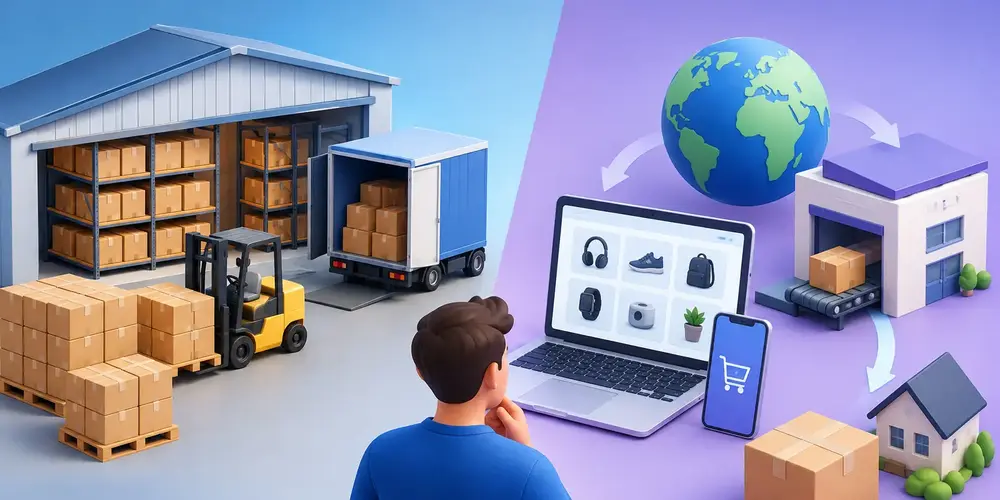
If you need to choose between wholesale and dropshipping for your business, the main question is not which model sounds simpler. You should evaluate how quickly a product will reach the buyer, how much control you want over orders and how much money you can invest in inventory. For one trader, the most important thing will be to start with minimal risk, for another - to ensure regular delivery and more stable profit from each unit.
A retail buyer usually sees only the result: whether a product is available, how much it costs and how quickly they can receive it. However, behind this purchase are different work processes. In wholesale, the seller purchases products in advance and stores them in their own warehouse. In the dropshipping model, the order is passed to the supplier, who sends the product directly to the end buyer.
Neither of these models can be called correct for everyone. The choice should match the product category, sales volume, supplier performance and your ability to serve customers.
How wholesale works
Wholesale means that a business orders products in larger quantities, receives them in their own warehouse and then sells them further one at a time or in sets. This model requires an initial budget, space for storing goods and regular inventory management. In return, it offers a significant advantage - the product is already with you.
If a customer orders hair accessories, gift bags, office supplies or seasonal decorations, items in stock can be assembled immediately. The seller themselves checks the packaging, can combine several product groups in one shipment and responds faster if the customer has special delivery requirements. This is practical for both online shops and physical retail locations, market traders and businesses that regularly replenish their assortment.
The wholesale pricing structure typically allows for a larger markup. When buying in larger quantities, the cost of purchasing and delivering a single product is often lower. This does not mean that each item will automatically be profitable. You also need to consider packaging, warehouse work, payment processing, advertising, discounts and possible product returns.
The risk of this model is unsold inventory. If an order is placed too optimistically, money gets tied up in products that do not sell for a long time. Special care should be taken when planning products with a short season, rapidly changing fashion or limited demand. On the other hand, everyday consumer goods, small household items, packaging, accessories and other regularly requested categories are often more predictable.
How dropshipping works
Dropshipping allows you to offer products without your own inventory. When a buyer places an order in your shop, the information is passed to the supplier, and they assemble and send the package. Initially, this seems particularly convenient: you do not need to rent a warehouse, you do not need to purchase large quantities of goods and you can more quickly test interest in new categories.
This model is useful if a business is just testing the assortment or wants to offer a wider selection without taking on full inventory risk. For example, you can test whether buyers are interested in a particular type of home goods or gifts before making a larger purchase. If demand is stable, the most popular items can later be moved to your own warehouse.
However, dropshipping does not relieve responsibility to the customer. The buyer places the order with you, so questions about delayed delivery, damaged goods, incorrect assembly or returns will come to you. If the supplier's warehouse stock is not updated in time, it can happen that a product visible in the shop is actually no longer available. This creates extra work and can reduce trust in the shop.
Another important factor is delivery time. If the supplier is far away or processes orders slowly, the end buyer will have to wait longer. This may be acceptable for specific, rare or more expensive items, but not always suitable for everyday purchases. A buyer who needs a gift, school supplies or seasonal goods in the near future will usually choose a location with clear availability and understandable delivery.
Wholesale or dropshipping in terms of profit
When comparing profit, you should not look only at the product purchase price. In wholesale, the initial investment is larger, but the price per unit is often more favourable. Moreover, it is possible to create sets, add related products and reduce the cost of one package if the customer purchases several products.
In the case of dropshipping, initial costs are lower, but the supplier has usually already included their picking and shipping costs. This can leave less room for markup. If competitors are selling identical products, price comparison becomes very easy, and profit can decrease even further.
Repeat orders should also be considered. If a company regularly sells the same products, its own inventory often becomes more economically justified. If demand is irregular or the product range changes every month, dropshipping can be a safer first step.
Control over customer experience
Product availability and order quality directly affect repeat purchases. In your own warehouse, it is possible to see the actual stock, inspect goods before dispatch and choose appropriate packaging. If necessary, you can quickly replace a damaged unit or add an extra product to an order. Such control is valuable for businesses that build a regular customer base.
In the dropshipping model, experience depends on the supplier's discipline. Before partnering, you should clarify how often warehouse stock is updated, how orders are processed, what the return procedure is and whether the shipment will include the supplier's branding or documents. Without clear answers, the risk passes to your business.
Lutini.lv product availability indicators and product codes are useful for businesses that want to plan repeat purchases and top up popular items more quickly. This is especially important if you need to purchase products from different categories in one order – rather than sourcing each one from a different supplier.
A practical way to choose a model
Before making a choice, it is enough to honestly answer a few questions. Is a particular product sold regularly? Do buyers expect fast delivery? Do you have space and resources for storing inventory? And can the supplier reliably provide current availability and delivery?
If the answer to the first two questions is yes, wholesale is often more practical. Start with a limited quantity, track sales speed and replenish stock based on real data, not guesses. This can reduce the risk of unsold goods while maintaining fast service.
If you are still unsure whether the product will have demand, dropshipping can be used to test. When stable order volumes are visible, the most cost-effective and popular items can be purchased in bulk. Such a combined approach is often more sensible than a strict choice of just one model.
Don't forget about daily processes
A good choice on paper will not deliver results if order processing is unclear. In wholesale, accurate stock must be maintained, minimum inventory levels must be set and time must be allowed for goods to be received. In the case of dropshipping, there must be regular communication with the supplier and clear information to the customer about delivery timescales.
In both models, product descriptions must be accurate. Size, material, contents, colour and quantity in the package help reduce misunderstandings. The fewer questions a customer has after a purchase, the less time needs to be spent solving problems.
Choose a model based on what you can deliver every working day, not based on a promise of easy profit. Transparent inventory, clear delivery times and honest information about the product are more valuable in the long term than a wide but uncontrolled range.