Before guests arrive, preparing the festive table is usually prompted not by an ideal picture, but by a practical question: will everyone have enough space at the table, crockery and freedom to move? A beautiful table is not necessarily expensive or overcrowded. It is thoughtful - with a unified atmosphere, a clean surface and details that do not interfere with conversation and the meal.
Family dinners, children's birthday parties, work team events or small café celebrations have different requirements. However, the basic principle remains the same: first choose a base suitable for the table size and number of guests, then the crockery and only then the decorations. This sequence helps avoid buying unnecessary items and prevents a chaotic result.
Start with the table's function, not decoration
Before laying the tablecloth, clarify how the meal will be served. If dishes will be on a communal table, space must be left in the centre for bowls, drinks and serving. If the meal is served in portions, you can afford a bit more decoration. At children's events, preference should be given to easy-to-clean and safe details rather than glass vases or tall candlesticks.
Consider the lighting as well. In a dark room, a dark tablecloth, brown crockery and dark napkins can merge into one mass. In a bright room you can use more expressive colours or patterns, but one main accent is enough. If the table is already made of beautiful wood, a tablecloth is not necessarily required - it can be replaced with a table runner, placemats or simply napkins at each place.
A practical solution is to measure the table's length and width before purchase. This allows you to choose an appropriately sized tablecloth, runner and disposable covers. A tablecloth that is too short looks accidental, whilst one that is too long can catch on chairs and prevent guests from sitting down.
Colour choice in festive table decoration
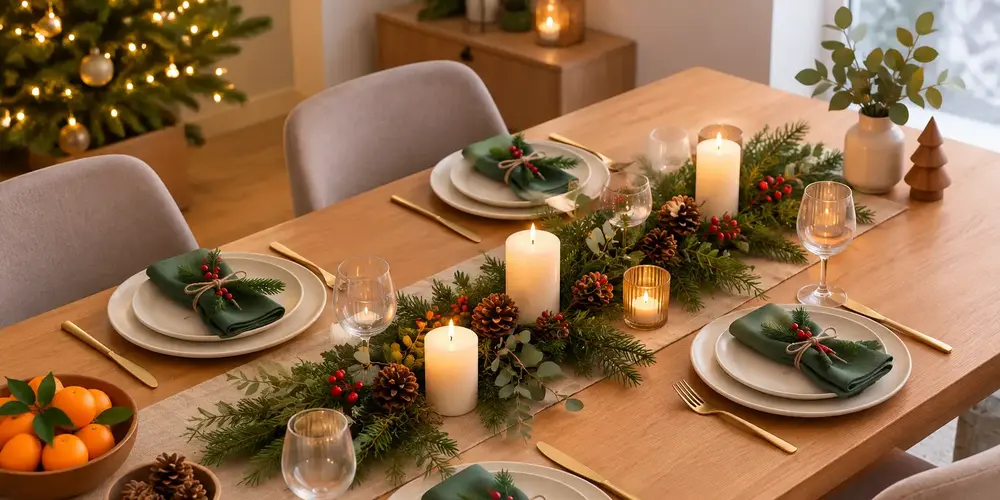
For the table to look neat, two base colours and one accent are enough. For example, white and beige as a base with a green accent works for family lunches any season. For winter celebrations, red, green, gold or silver are often chosen, whilst for spring celebrations - bright yellows, pinks, greens or blue tones.
It is not necessary for every item to be in one colour. Quite the opposite - napkins, candles and small decorations chosen in matching tones often look more natural than a completely coordinated set. If you use a patterned tablecloth, choose plain napkins and neutral crockery. If the tablecloth is plain, an accent can be created with napkins, paper crockery, ribbons or seasonal decorations.
In a small space and on a narrow table, light colours work better. They create a sense of more free space. Dark tones are worth choosing if the table is wide, the room is well lit and the celebration calls for a more relaxed, formal atmosphere.
A unified theme makes the shopping list easier
A theme does not mean that every detail must have a specific image. It can be a simple colour combination or material - nature, wood, sparkle, pastel tones or bright party colours. Once you choose a theme, it immediately becomes clear what napkins, tablecloths, balloons, candles and small gift details will be needed.
For retailers and event planners, this approach is particularly convenient when building seasonal stock. There is no need to cater to only one narrow design. It is more practical to assemble neutral base elements - white or kraft napkins, plain tablecloths, transparent crockery - and supplement them with seasonal accents.
Crockery, napkins and space for each guest
Table setting begins with space for a person, not with decoration in the centre. One guest needs enough space for a plate, glass and elbows. If table space is limited, you do not need to place all possible table accessories. Choose only those that will be necessary for the particular meal.
Everyday crockery can be successfully combined with festive details. White plates are a universal base as they can be used with coloured napkins, paper glasses or decorative placemats. Disposable crockery is useful for larger celebrations, children's parties and outdoor events as it reduces the volume of washing up after the event. However, you should assess whether they will be sufficiently durable for the planned food and drinks.
A napkin is a small but noticeable detail. It can be placed on the plate, next to accessories or put in a glass. Complex folds are not necessary. A neatly folded napkin with a small ribbon, sprig or place card often looks better than a decoration that takes a long time to assemble.
If there are several drinks on the table, glasses or mugs should not be placed too closely together. Guests should be able to pick them up without touching their neighbour's place setting. At events with children, coloured markers, stickers or name cards are useful so that drink containers don't get mixed up.
Decorations that don't take up table space
A centrepiece is only suitable if it doesn't obstruct the view or the serving of food. Tall vases, wide candelabras and large flower bouquets can look impressive in an empty space, but at a full table they become impractical. A safer choice is low decorations: small candelabras, short flower arrangement containers, seasonal branches, pine cones or small themed ornaments.
Candles should be handled with care. They must not be placed next to paper napkins, balloons or easily flammable decorations. If there are children at the event or the table is tightly laid, a practical alternative is decorative LED lights or small lanterns.
You can control the amount of decoration with a simple check: set the table, sit at each place and make sure you can clearly see the person across from you, place your plate and reach your drink. If the answer is no, remove the decorations first, not the dishes.
Four items worth preparing as backup
Most celebration problems are not related to design, but to small items that run out at the wrong time. Before the event, prepare spare napkins, glasses or mugs, bin bags and paper towels. Keep these items in an easily accessible place, but not necessarily on the table itself.
If you are planning to host a large group of guests, a separate drinks or snacks table is also useful. This reduces crowding on the main table and gives guests more space. In businesses, guest houses and retail locations, such an arrangement also makes it easier to replenish the table during the event.
How to plan purchases without unnecessary units
First, make a list of guests and add a small reserve for unforeseen circumstances. Then write down what you already have at home or in the warehouse: tablecloths, plates, glasses, candles, napkins, decorative ribbons. Only then create your shopping list. This protects you from the situation where several similar decorations are bought, but practical items are lacking.
When shopping for multiple celebration occasions or business needs, choose items that can be reused at different events. Neutral tablecloths, simple dishes, plain-coloured napkins and small candelabras are easier to mix and match than very specific themed decorations. Seasonal accents can be changed, but the basic stock can be used all year round.
The Lutini.lv range approach is convenient precisely for such purchases, when one order requires both festive details and everyday household items. Before placing your order, check the available quantity and the number of units per package, especially if you are preparing for an event with a larger number of participants.
The final step before guests arrive
Photograph the prepared table or view it from the entrance. You will immediately see whether the colours work together, whether there are too many objects in the centre and whether each place has everything it needs. Then leave on the table only what helps the meal and the atmosphere. Guests will appreciate not the amount of decoration, but the opportunity to sit comfortably, converse and feel welcomed.