A guest often notices not expensive interior design, but practical things: whether there is a clean towel, where to put a bag, charge a phone and find what is needed without calling reception. Therefore, when planning what to include in a guest room package, start with basic needs and only then add amenities. A properly equipped room makes it easier for both the guest's stay and the staff's work between bookings.
The package does not have to be the same in all properties. A hotel, guest house, short-term flat and seasonal holiday cottage have different room sizes and guest expectations. However, the basic principle remains unchanged: the room must be clean, functional and have understandable equipment that is easy to regularly replenish.
What to include in a guest room package first
First is the bed and quality, clean textiles. The guest should receive a sheet of appropriate size, duvet cover, pillowcase, duvet and pillow. If the room has an additional bed, its textiles should preferably be prepared in advance or placed in a clearly marked location. Mixed size assortments create extra work for staff and inconvenience for guests.
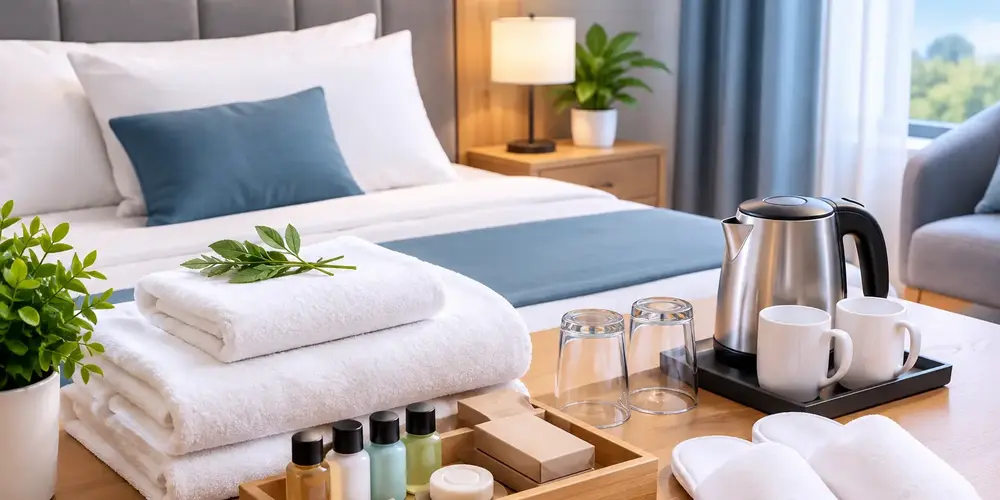
The quantity of towels is also important. A practical minimum for one guest is a bath or shower towel and a smaller hand towel. In properties with longer stays, an extra towel or clear instructions on how a guest can request a change are useful. White textiles look neutral and make it easy to check cleanliness, but darker tones can be suitable in areas with very high turnover. The choice depends on the washing process and the ability to maintain a uniform stock.
At least one bedside table or stable surface next to the bed is necessary, where guests can place glasses, a phone or a glass of water. If possible, also provide an accessible socket. Many guests travel with several devices, so one hard-to-reach socket behind a wardrobe is not enough. The room also needs main lighting and a smaller reading lamp or light fixture by the bed.
Bathroom: cleanliness, hygiene and safety
The basic bathroom package should include toilet paper, soap for hand washing, a waste bin and a clean bath mat, if the room has a shower or bath. It is important to leave not only one opened roll of toilet paper, but also at least one spare roll in a visible, dry place. This is a detail that reduces unnecessary calls and negative reviews.
In the shower area, shampoo and shower gel or universal washing agent are usually needed. Individual packages are hygienic and convenient for short stays, whilst refillable dispensers may be more suitable for places with regular high occupancy. In the case of dispensers, strict filling and cleaning procedures must be introduced. An empty or dirty dispenser creates a worse impression than a simple but tidy solution.
Do not forget about a hair dryer, towel rails and space for hygiene items in the bathroom. A small shelf by the sink is more practical than a beautiful but narrow space where the guest has nowhere to put a toothbrush or cosmetics bag. If there is a window, provide a blind for privacy. If there is no window, ventilation and regular moisture control are especially important.
Furniture and storage without unnecessary clutter
A room does not gain value from furniture that takes up space but is not used. Guests typically need space for a bag, clothes, shoes and everyday items. Depending on the room size, this can be a wardrobe, open clothing rack, chest of drawers or shelves. The main thing is that the solution is stable, clean and sufficient for the intended number of guests.
Hangers are a mandatory detail, especially in rooms where business travellers or guests stay several nights. It is advisable to choose hangers of the same type that are durable and easy to replenish. A full-length mirror, a chair or small stool and a place to put suitcases are also useful. A luggage rack helps keep the bed cleaner and protects walls from scratches.
In a small room, do not try to fit everything. If space is limited, priority should be given to bed comfort, safe movement space and storage, rather than decorative items. Free passage is also essential for cleaning and fire safety.
Beverages, information and everyday details
If tea or coffee is offered in the room, a complete and consistent package is needed: mugs, teaspoons, teapot or coffee machine, sugar, sachets and a waste solution. Single-packaged tea and coffee make accounting easier, but the stock must be replenished after each stay. If the hot beverage area cannot be kept in order, it is better not to include it in the room offering.
Drinking water is a pleasant addition, but its necessity depends on the type of property and its location. Guests in any case need to clearly know whether tap water is drinkable and where it can be obtained. Information can be brief, legible and placed by the table or at the entrance.
It is also useful to have clear information about Wi-Fi, check-out time, breakfast, car park, quiet hours and contact details for urgent questions in the room. There is no need for a thick set of promotional materials. One proper information sheet is easier to maintain and guests can find it more quickly. If the room has air conditioning, heating, a television or other equipment, add brief instructions for use.
Safety equipment is not a matter of choice
Guest rooms must have working smoke detectors in accordance with the property's requirements, safe electrical installations and free access to the exit. Extension cords, wires and lamps must be checked regularly. Damaged chargers, loose sockets or furniture that could tip over must not be left unattended.
First aid kits and fire safety equipment must be accessible in accordance with the building's organisation, even if not in every room. Guests must be able to quickly find information about what to do in an emergency. Bathrooms should be checked especially carefully: non-slip surfaces, secure mats, sturdy handles if needed, and adequate lighting.
Create a uniform room restocking procedure
The cheapest way to maintain quality is not to improvise each time, but to use one checklist for each room type. It specifies the amount of linens, toiletries, beverages area, technical checks and cleaning points. Staff then sees not only what needs to be put in, but also what needs to be checked before the next guest arrives.
Stocks are conveniently divided into two parts: daily consumption in the room and reserves in the warehouse. Reserves must include at least the most frequently used products – towels, bed linen, toilet paper, soap, bin bags, tea and coffee portions, batteries and light bulbs, if they can be changed in that particular room. A uniform product range simplifies ordering, inventory and replacement.
Lutini.lv's wide range of household, home goods and products designed for guest needs can be a convenient solution when you need to replenish multiple product groups in one order. Before ordering, review actual consumption data rather than relying on intuition alone. Seasonal occupancy, number of rooms and average length of stay significantly affect the volume of reserves needed.
What is often forgotten
Most often problems are caused not by large purchases, but by small things: lack of hangers, no bin bag, remote control not working, mirror poorly lit or no space for a phone by the bed. Therefore, after cleaning, it is worth inspecting the room from a guest's perspective. Come in with a small bag, put your phone on charge, check the shower and try to find the Wi-Fi password without assistance.
A good guest room is not one with a maximum amount of things. It is a room where each item has a clear purpose, it is clean, in working order and easy to restock. Start with a solid basic set, note the most common guest questions and adjust the contents based on real experience. That way the room will become more comfortable for guests and simpler in day-to-day work.