The best products for guest houses aren’t necessarily expensive – they need to be practical, easy to restock and suitable for regular use.
Furnishing a guest house is a matter of day-to-day management, not a one-off purchase. Items are used, washed, lost and wear out. It is therefore worth drawing up a shopping list based on the rooms and guest numbers, whilst choosing items that can be reordered from a single supplier at predictable costs.
The best items for guesthouse rooms and overnight stays
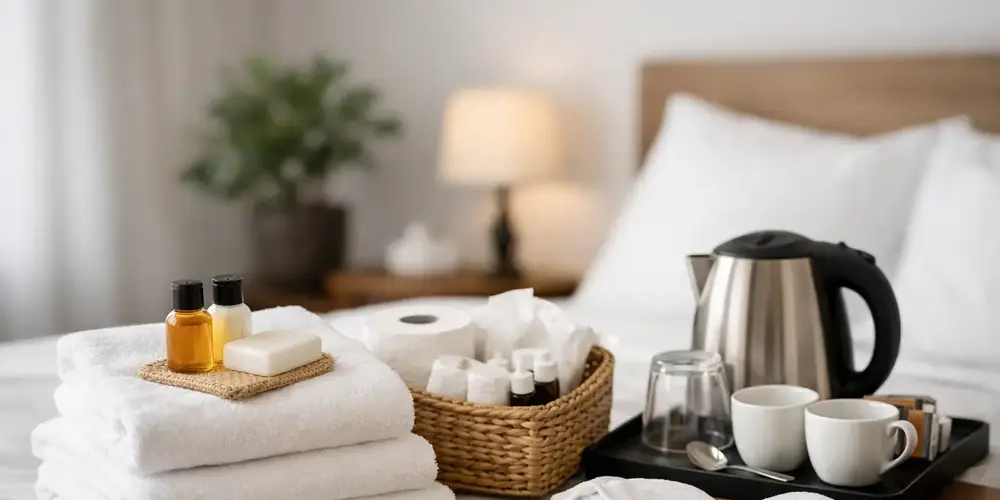
The basic room amenities should help guests spend a comfortable night without having to ask the host for anything extra. The most important things are clean bed linen, towels, pillows, duvets and functional lighting. If the guesthouse accommodates different types of travellers, such as families, work groups or couples, it is also useful to have an extra duvet and pillow in stock.
Don’t choose bed linen based on appearance alone. Sets in white or neutral colours are easier to mix and match and to replace if any item is damaged. Very thin fabric may cost less initially, but it can lose its quality more quickly with frequent washing. For a smaller guesthouse, at least two to three sets of bed linen per bed are sufficient to ensure that changes can be made without rushing.
Towels are another item that needs to be replenished frequently. A practical minimum is one bath towel and one small hand or face towel per guest. In saunas, swimming pools or countryside holiday destinations, demand will be higher, so a separate reserve is needed in stock. Matching towels make sorting them out after washing easier and give the room a tidier appearance.
Other useful room amenities include coat hangers, clothes hooks, waste bins, bedside lamps, mirrors, alarm clocks and slippers. Not everything is needed in every location straight away. For example, slippers will be more valuable in a guest house with a sauna area or cold floors, whilst in a short-stay city accommodation, the priority may be luggage storage and coat hooks.
Bathroom essentials that prevent unnecessary requests
In the bathroom, a guest immediately notices whether daily needs have been taken into account. A soap dispenser, toilet paper, a waste bin, a bath mat, a toilet brush and spare towels are the essentials. If the room has an en-suite bathroom, each room should have its own full set, rather than just a shared supply in the corridor.
Disposable or small-sized guest toiletries help to keep things tidy and minimise misunderstandings. Shampoo, shower gel, soap, a toothbrush, toothpaste and a shower cap are particularly useful for guests staying for just one night or who have forgotten their personal hygiene items. There is no need to stock a wide range of toiletries in every room. It is better to provide a clear, minimum selection that is regularly replenished.
Dispensers are more economical than lots of small bottles if the guesthouse has a steady occupancy rate and staff regularly check the rooms. On the other hand, small packs are more convenient in places where guests change frequently, or if you wish to minimise product wastage and maintain a consistent standard of service. The choice depends on the number of rooms, the cleaning schedule and the length of guests’ stays.
Cleaning supplies do not usually need to be placed in plain sight for guests, but the housekeeping stock should include paper towels, bin bags, sponges, microfibre cloths, gloves and suitable cleaning products. These are minor costs compared to a situation where a room cannot be quickly prepared for the next guest.
Communal areas and the kitchen
The breakfast room, communal kitchen, terrace or lounge are the areas where equipment wears out the fastest. The key here is to choose simple, durable and easily replaceable items. You should buy crockery, mugs, glasses, cutlery, trays and napkins in bulk, as individual items will break or go missing.
It is also a good idea to keep chopping boards, kitchen towels, pot holders, bowls, tin openers, bin bags and food storage containers in the kitchen. If the kitchen is intended for guests’ use, clear instructions on how things should be kept are often just as important as the items themselves. For example, labelled rubbish bins and a designated area for shared food help to minimise clutter.
In the communal area, an umbrella stand, coat hooks, a shoe rack, small rugs, waste bins and board games or items designed to keep children occupied are useful. If the guest house accommodates families, a small, easy-to-clean set of toys will be more practical than expensive décor that children are not allowed to touch. During peak season, you can add mosquito repellents, a supply of blankets or rain ponchos.
Items for reception and day-to-day organisation
Even a small guesthouse needs items to help organise check-in and day-to-day operations. Numbered key tags, pens, notepads, document folders, price tags, stickers and packaging materials make day-to-day processes easier. If you sell souvenirs, drinks or small travel items, gift bags and small items for the till area are also useful.
Guests often find charger adaptors, extension leads, batteries, sewing kits, shoe-cleaning sponges and first-aid supplies useful. These items do not need to be handed out to every visitor, but they should be easy to find. A good solution is a small shelf for guests’ essentials or a reception kit that a member of staff can hand out on request.
How to choose items for a guest house without excess stock
It is not cost-effective to base purchases solely on the lowest unit price. You need to assess how quickly an item will wear out, how much space it will take up in the storeroom, and whether it will be possible to restock it even after a few months. A uniform colour and style for towels, hangers or dispensers helps to avoid a chaotic appearance and simplifies stock management.
Start with three stock groups: items needed in every room; items used on a daily basis; and reserves for unforeseen situations. The first group includes a coat hook, a mirror and a waste bin. The second comprises toilet paper, soap, bin liners and cleaning supplies. The third consists of extra bed linen, towels, light bulbs, batteries and hygiene kits.
Opting for larger packs is usually cost-effective for regularly used items, but only if you have a dry and organised place to store them. A small guesthouse doesn’t need to buy too many specific decorative items or seasonal goods that might end up in storage until next year. A wide range is valuable if it helps to fulfil basic needs in a single order.
From the Lutini.lv range, guesthouse owners can easily select everyday household goods, textiles, hygiene products, seasonal items and small goods, whilst checking available stock before placing an order. For regular purchases, it’s worth keeping a list of your staple items with their product codes and required quantities – this speeds up reordering.
Review your stock levels ahead of the busiest weekends, public holidays and event seasons, rather than just when something runs out. If a minimum stock level is set for each item, the guesthouse can prepare rooms with peace of mind, maintain consistent quality and purchase what is needed in good time, rather than in a rush and at a higher cost.