
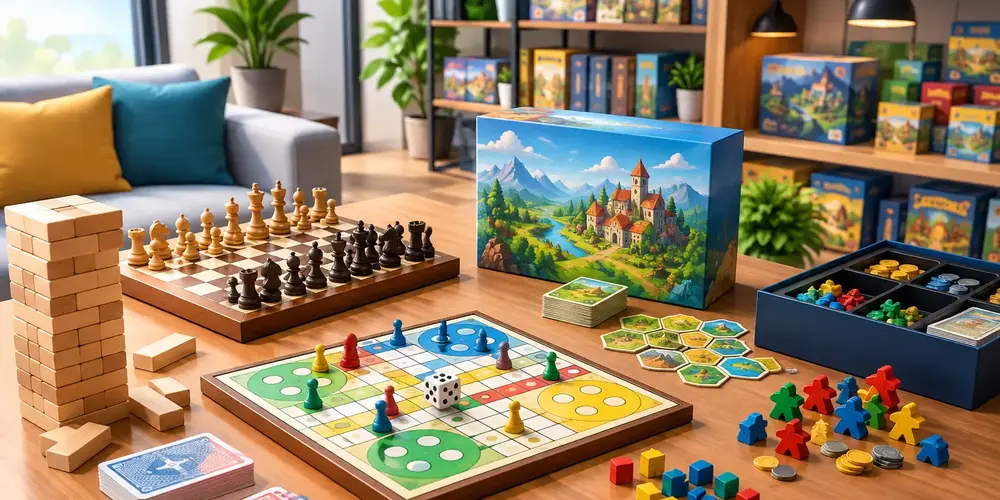
When phones are full of the same videos, popular board games offer a simple reason to gather round a table. They are useful for a family evening, a child's birthday, a trip, a guest house or a small group of friends. For the buyer, it is important not only what the game is about, but also how quickly it can be started, how many people can participate and whether the rules will be understandable without lengthy explanation.
The selection of board games is wide, so it is most practical to start not with the most attractive box, but with the intended situation. A short card game fits well into a spontaneous evening, whilst a classic strategy game is more suited to a quieter time, when participants are ready to follow more rules. In retail and resale, the same principle helps create an understandable, sought-after range.
How to choose popular board games
First, you should look at the age of the players. The age indicated on the box is not just safety information. It often tells you whether a child will be able to keep up with turns on their own, read tasks and make decisions. If a game is intended for younger children, the advantage is large, durable pieces, clear images and short rounds.
The next question is the number of participants. A game for two is not automatically a good choice for a party of six, whilst a game for a large group may not be convenient for a family with three members. Universal games with multiple players are usually a safe choice for a gift and shop shelf, as buyers find it easier to adapt them to different situations.
Duration is also important. A game that lasts ten to twenty minutes often makes it easier to find time on a weekday evening. A longer game format offers more opportunity to plan and compete, but requires patience. If a game is bought for children or for travel, shorter formats are usually used more often.
Another practical criterion is language. Games with numbers, colours, images and simple symbols are convenient for participants of different ages. They can also be used if there are people in the group with different language skills. Quizzes and word games, on the other hand, are interesting if all players understand the language and theme used well.
Types of games most in demand
Classic board games remain popular because the rules are mostly already known. Dominoes, draughts, chess, lotto and various dice games are not dependent on fleeting fashion. They are understandable, compact and suitable for both homes and places where guests need simple leisure activities.
Card games are especially convenient because of their size. They can be taken along on a trip, and often one box contains several game variants. Here you should pay attention to card quality and size: cards that are too thin wear out quickly, whilst cards that are very large are uncomfortable for small children to hold in their hands.
Games based on speed and reaction work well in active groups. Players look for matches, quickly place pieces, guess images or react to signals. This format provides a lot of fun and engages even those who do not want to count points for a long time. However, for younger children or quiet rest, it can be too loud and tense.
In strategy games, the main thing is planning. These can be games with a board, tokens, territories, resources or combinations. This format appeals to people who want to think through every move, but for beginners, complex rules sometimes reduce the desire to play again. If a game is bought as a gift and the recipient's interests are not known, a simpler beginner level is a safer choice.
Creative and guessing games are suitable for celebrations, teams and families with older children. You can draw, explain words, act out tasks or answer questions in them. Their strength is the conversation between participants. To prevent the game from stopping after the first evening, a wide range of tasks or cards is useful.
A complicated box is not needed for a family evening
In a family, people of different ages and experience often play. That is why the best choices usually allow you to get involved immediately, without waiting for your turn too long. It is important for a child to feel that he can win with attention or luck, rather than just watching adults work out complicated steps.
The balance between luck and skill is essential. If everything is determined by chance, adults may get bored with the game quickly. If everything is determined by experience, the youngest player will lose interest. Good family formats offer the opportunity to choose, take risks, notice details and at the same time leave room for an unexpected outcome.
Before making a purchase, it's worth thinking about table space. Some games take up little space and are convenient in the kitchen or on the go. Others need a large surface to lay out the board, cards and pieces. Compact packaging is also important if the game is intended for storage in a flat with limited space or for sale in a seasonal gift range.
What to consider when building a game assortment
For a retailer or small shop owner, board games are a practical category, as they are purchased both for everyday use and as gifts. However, there is no need to choose only complex novelties. Stable demand is usually formed by well-known formats, children's games, compact travel variants and games for groups.
It is useful to divide the assortment according to clear customer need: games for younger children, for families, for two players, for a night with friends and for travel. This logic makes it easier to find a product quickly, even if the customer doesn't know the specific name of the game. In the product description, it is valuable to indicate the recommended age, number of players, approximate duration, contents of the set and the game language.
The quality of the set must be taken into account. Check that the box is tightly closed, the pieces are complete and the rules are clear. A game with small elements is not the best choice for places where it will be used frequently and where pieces can go missing. In such situations, simpler sets with durable components are more economical.
Seasonal demand is also noticeable. Before holidays, people more often search for gift games with attractive packaging, whilst in summer interest increases in compact games for travel, camps and outdoor recreation. In stock planning, visible availability and the ability to replenish popular formats in good time are useful. Lutini.lv's extensive product catalogue is convenient if you need to replenish not only toys but also a gift or seasonal product range in a single order.
How to prevent a game from being put aside
A good game alone is not enough if the first evening starts with a long rules reading. First, briefly explain the purpose of the game, then show one trial move. The remaining rules can be added during play when they become necessary. This way participants start acting faster and are less afraid of making mistakes.
At home, a simple routine is useful: after the game, pieces are immediately placed in a separate bag or compartment, and the box is stored in a dry place. Cards will last longer if they are not used on a wet surface and not bent. If the game is used in a guest room or children's corner, it is worth choosing a set that can be quickly checked and tidied up.
The most popular game is not always the one with the most pieces or the most complex rules. Most often people return to the one that can be picked up quickly, easily explained and played with pleasure in different company. This is exactly a good guide for both home purchases and a well-considered game assortment.