
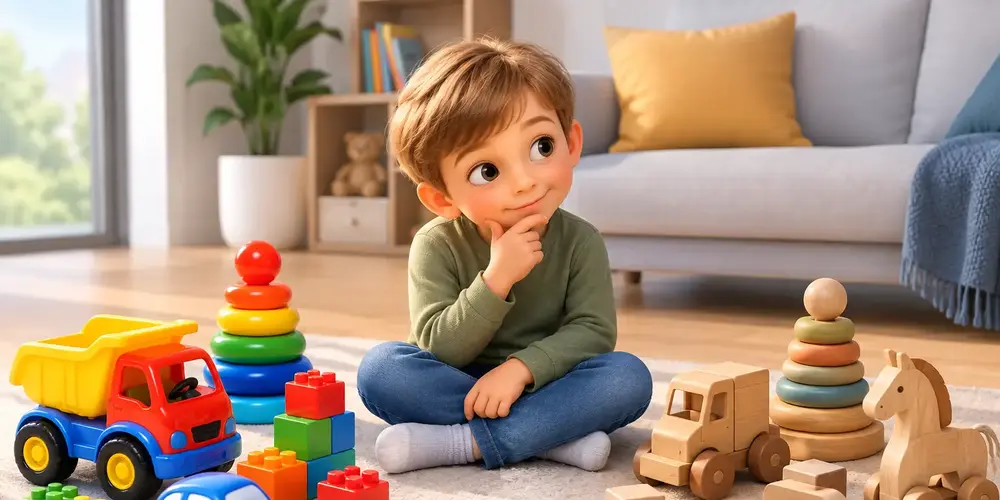
For children, it often doesn't matter whether a toy is made of wood or plastic - what matters is that they can play with it straight away and repeatedly. For parents, gift buyers and shop owners, the question of plastic or wooden toys is more practical: which will be suitable for the age, withstand daily use, be easy to maintain and meet the planned purchase?
The material itself does not determine the quality of a toy. Both wooden and plastic products can be safe, well-made and engaging for a child. The choice is more influenced by the type of toy, the child's abilities, the intensity of use and whether you are buying one gift or adding to a wider range.
Plastic or wooden toys: the main difference
Wooden toys are often chosen for their simple shapes, pleasant feel in the hand and classic design. They fit well into sets of first building blocks, shape sorters, puzzles, pull-along toys and role-play sets. If a toy doesn't have many moving parts, quality wood can last a long time and withstand regular use well.
Plastic offers more possibilities for shapes, colours and functions. From it you can make lightweight vehicles, sand sets, figurines, dolls, kitchen accessories, construction pieces and toys with mechanisms. It is especially useful where fine details, rounded shapes or light weight are needed.
Therefore, the comparison is not about which material is always better. A wooden puzzle and a plastic fire engine serve different purposes. One can develop shape recognition and patience, the other can encourage movement, storytelling and role-play.
Safety begins with age indication and manufacture
When buying a toy, first check the manufacturer's stated age, warnings and labelling. Small children should not have small parts that could end up in the mouth or airways. This applies to both small plastic construction elements and wooden beads, blocks and detachable parts.
For a wooden toy, examine the surface. It should be smooth, without splinters, cracks and peeling paint. If there is a painted or varnished finish, it should be even and durable. This is especially important for toys that a child might put in their mouth.
For a plastic toy, check that there are no sharp edges, cracks or poorly attached parts. A quality product should have parts that hold firmly, wheels and caps that don't come off after a few play sessions, and a surface that is not sticky or with a strong, sharp smell. If the toy has a battery compartment, it should be securely closable.
Safety is also affected by where it is used. Bath and sand toys should be easy to wash. A toy designed for quiet play indoors won't always be suitable for frequent throwing on the floor or use outdoors.
For younger children - fewer complications
Babies and young children usually benefit from simple, easy-to-grip toys with large parts. Wooden rings, blocks and shape sorters can be a good choice if they are properly made. Large plastic toys with rounded edges are also practical, as they are usually light and easy to wash.
At pre-school age, a child already chooses toys more often based on interest. This is where vehicles, animal figurines, dolls, toy utensils, sand sets and simple construction kits come in handy. Material becomes less decisive than play possibilities.
Durability, maintenance and everyday use
Wood can withstand time very well, but it is not indifferent to moisture. Wooden toys should not be soaked in water for long or left in the rain. They are usually cleaned with a slightly damp cloth and then dried. If a toy is damaged, with cracks or a peeling coating, it should no longer be given to the child to play with.
Plastic is often more convenient for active daily use. It can be quickly wiped, washed and used outdoors if the toy is designed for it. This is a significant advantage for nursery groups, homes with a children's corner and families where toys are often moved from room to yard.
However, a plastic toy won't always be more durable. Thin parts can break, and complex mechanisms can wear out. On the other hand, a solid wooden block can last for years. Evaluate the specific model: wall thickness, connection quality, part attachment and whether the toy's construction matches the intended load.
The type of play is more important than the material
If the goal is to develop hand dexterity, logical thinking and concentration, puzzles, sorters, blocks and construction toys work well. Wood is a frequent choice in these categories, but plastic sets can also be convenient, colourful and easy to maintain.
If a child enjoys stories and role play, there are even more options to choose from. Plastic figurines, toy food, dolls and vehicles allow you to create larger sets with many pieces. A wooden shop till, kitchen or train can be suitable for longer, quieter play at home.
Movement toys often need a light and durable material. Balls, sand moulds, water toys and most outdoor sets are usually more practical in plastic form. On the other hand, wooden push toys and balance elements are a good solution for dry rooms or a protected outdoor environment.
How to choose a range for a shop or institution
Sellers and purchasers are not well served by basing their entire offer on just one material. Buyers are looking for different products: one wants a small gift, another a toy for travel, and yet another wants multiple identical items for a children's event or a retail location.
In a wider range, it is useful to combine both types. Wooden toys create a stable, classic category for gifts and educational games. Plastic toys help ensure a wide choice of colours, themes and prices, especially for seasonal, outdoor and role play items.
Before placing an order, review not only the pictures, but also the size, the number of pieces included, the age indication and the available quantity. If the item is intended for resale, it is useful to choose several similar models in different colours or themes. This allows the buyer to choose, whilst you maintain an understandable and repeatedly replenishable shelf.
When to choose wood and when plastic
Wood is often suitable when you need a simple, tactile toy for quiet play, educational tasks or a gift with a classic appearance. It works well in blocks, puzzles, sorters and toys without complex electronics or many moving joints.
Plastic is often better when you need a light, washable, colourful or multifunctional toy. It is practical for outdoor games, sandboxes, figurine sets and vehicles. Likewise, plastic often allows you to include more pieces in a set and various play scenarios.
If you are unsure, start not with the material, but with the child's age and play habits. Choose a toy that will be easy to use, store and maintain - it will much more often become a real everyday favourite rather than remaining unopened on a shelf.