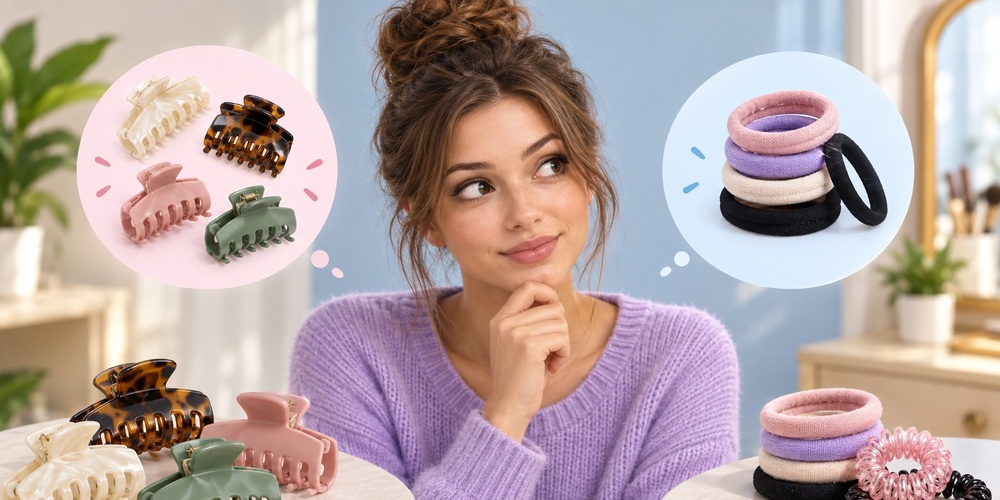
However, appearance is not the only consideration for customers and retailers. Hair thickness and length, the material of the accessory, frequency of use and whether the item is intended for personal use or for sale as part of a wider product range should all be taken into account.
Hair accessories are a small but practical product category with steady demand. They are purchased for everyday use, school, work, sport and special occasions, as well as small gifts. A varied selection of clips and hair ties makes it possible to meet different needs without making the customer’s choice unnecessarily complicated.
When to Choose Hair Clips
Hair clips are designed to secure individual sections of hair precisely. They are useful for keeping hair away from the face, securing a fringe, creating a half-up hairstyle or holding a particular style in place. A hair clip is usually more visible than a hair tie, which means it can serve as both a practical accessory and a decorative detail.
Small metal hair clips are well suited to everyday use. They are compact, easy to carry in a handbag and useful when there is no need to put all of the hair up. These clips are often purchased in sets because they can easily be misplaced, while a choice of colours makes it possible to match them with different outfits.
Larger automatic barrettes and claw clips are suitable for thicker and longer hair. They make it easy to lift the hair quickly or secure it at the back of the head. This is convenient during a busy day, but the strength of the spring and the shape of the teeth should be considered. A clip with a weak spring may slide out, whereas very sharp or tightly spaced teeth may cause discomfort.
Decorative hair clips featuring ribbons, beads, fabric elements or sparkling details are primarily intended to create a visible accent. They complement festive outfits, children’s hairstyles and simple everyday clothing. It is worth remembering that an eye-catching design is not always suitable for every occasion. Retailers should therefore offer neutral colours and classic shapes alongside more decorative styles.
Secure Hold Is Essential When Choosing a Hair Clip
Before purchasing a hair clip, it is worth checking how securely it holds the hair. Fine, smooth hair is often best suited to smaller clips that provide a good grip, while thick hair requires a larger clip with a stronger fastening mechanism. If the clip is intended for a child, it should be easy to open and close, and all small decorative parts must be securely attached.
Metal components should be smooth, with no sharp edges or uneven coatings. This reduces the risk of the accessory catching the hair or damaging fine strands. With fabric and plastic models, particular attention should be paid to the joints and attachment points, as these are the areas where wear is most likely to occur.
When Hair Ties Are the More Practical Choice
Hair ties are suitable when a larger volume of hair needs to be secured in a ponytail, braid, bun or another everyday hairstyle. They are usually the quickest solution for work, sport, household tasks and school. Their main advantage is ease of use: there is no need to find a specific strand of hair or adjust a fastening mechanism, as may sometimes be necessary with clips.
Classic fabric-covered hair ties are versatile and popular because they can be used with different hair types. They may be thin or thick, neutral or brightly coloured, plain or patterned. Sets containing several colours are practical for customers who want a choice of accessories for everyday use.
Seamless hair ties are often chosen by people looking for a gentler hold. They usually leave a less noticeable mark in the hair and are more comfortable to wear for extended periods. However, they may provide less hold in very smooth or heavy hair. For this reason, no single design will suit everyone.
Spiral hair ties are a convenient option when quick application and removal are the main priorities. They are frequently used as everyday accessories because they are less likely to become tangled in the hair. However, the spiral may stretch after prolonged use. This is less of an issue when the ties are purchased in a set and replaced regularly.
Fabric scrunchies are larger and more noticeable. They can be used both to secure the hair and to create a decorative accent. This option is particularly suitable for customers looking for a softer material or wishing to combine a practical and decorative accessory in a single purchase.
Hair Clips or Hair Ties for Different Hair Types
The main difficulty with fine hair is usually that accessories tend to slip. Small clips with secure fastenings, thinner hair ties and accessories with textured surfaces generally work well. Large, heavy clips may slide out, while a hair tie that is too tight can compress the hair and create unnecessary tension.
Thick hair requires a stronger hold. When choosing a hair tie, its elasticity and the density of the material are important. If it cannot be wrapped around the hair tightly enough, the hairstyle will quickly come loose. A clip must have sufficient capacity to hold the required volume of hair rather than merely gripping the outer layer.
Smooth hair ties without metal joins are often better for curly hair because they are less likely to catch. Clips can be used to secure individual strands, although very fine teeth may not always be comfortable. The most suitable choice depends on whether the aim is to preserve the shape of the curls or to secure the hair firmly.
Small hair ties and lightweight clips are suitable for children’s hair. They should be firm enough to keep the hairstyle in place throughout an active day, but not so tight that they cause discomfort. Colourful sets, animal shapes, ribbons and other playful elements help create an attractive range, but quality and a safe finish should always remain the highest priorities.
How to Create a Well-Balanced Product Range
Retailers should select hair accessories according to their intended uses rather than focusing on a single popular design. The core range should include black, brown and neutral everyday colours, as these are easy to combine with different outfits and are suitable for customers of various ages. They can be complemented by colourful sets, children’s accessories and styles designed for particular seasons or celebrations.
Sets are often more practical than individual items. Customers receive spare accessories, while retailers can offer a straightforward product that is quick and easy to choose. At the same time, individual large clips and distinctive decorative styles add variety to the range and allow customers to choose a more noticeable accent.
When purchasing stock, retailers should consider not only the design but also the number of items in each pack, the type of material, the size and the available stock level. Clear product information makes it easier to compare similar styles and place repeat orders. Lutini.lv’s broad range of everyday products is particularly convenient when accessories, gifts, stationery or seasonal items need to be replenished at the same time.
Use and Care for Longer-Lasting Accessories
Hair ties should not be overstretched, particularly when used on wet hair. Wet hair is more vulnerable to breakage, so hair ties should be removed carefully rather than pulled out. A tie should be replaced when it loses its elasticity or the fabric becomes damaged.
Hair clips should be stored in a small box or compartment to prevent them from becoming bent or lost among other items. If the fastening begins to catch or any parts become loose, the accessory should not be forced. Replacing it promptly helps protect both the hair and the hairstyle.
When choosing between hair clips and hair ties, there is no need to look for a single correct solution. Hair ties are ideal for putting hair up quickly and securely, while clips are useful for precise fastening and creating a visible accent. The most practical purchase is usually a selection of several types of accessory, ensuring that a suitable option is always close at hand.