
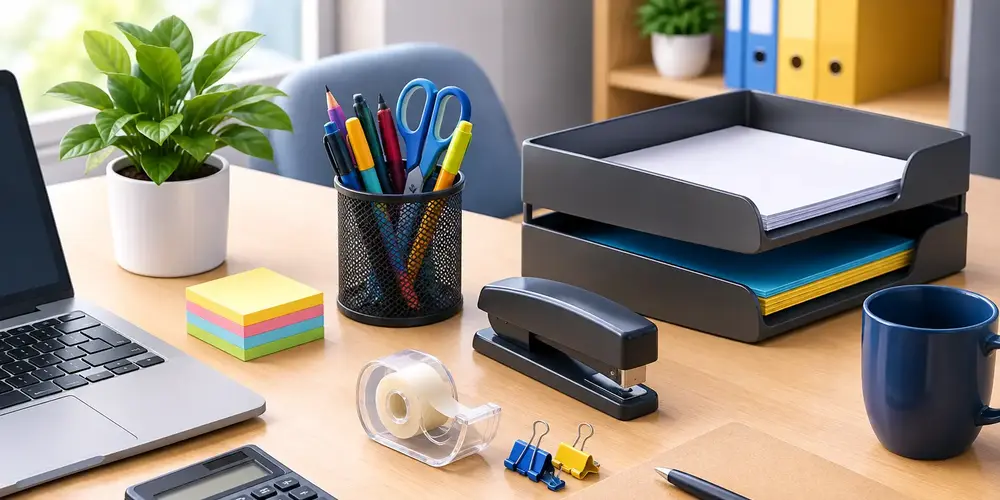
A pen, paper or folder may seem trivial until they run out just before printing invoices, meeting clients or the start of the school year. Budget office supplies allow you to keep your workspace ready for daily tasks without overpaying for items that are used regularly and in large quantities. For a small office, shop, hotel or home workspace, what usually matters most is not fancy design, but available stock, clear choice and convenient ordering.
Practical purchasing starts with a simple question: what is actually consumed in the workplace? For some it will be a pack of printing paper and envelopes, for others – price tags, markers, tape or document folders. By purchasing according to actual consumption, rather than just by promotion or package appearance, it is easier to maintain order both on shelves and in the purchasing budget.
How to choose budget office supplies
Cheap supplies are not automatically cost-effective. If a pen writes unevenly, a stapler jams or a thin folder falls apart quickly, it needs to be replaced sooner, and the initial saving disappears. That is why it is worth looking at basic function: will the product do the job reliably and repeatedly.
For everyday office needs, simple, tried-and-tested solutions usually suffice. A ballpoint pen should be comfortable to write with, a notepad should be stiff enough that pages don't tear, and document folders should be the right size and with a clear fastening type. There is no need to complicate the choice if the item is used briefly and frequently.
Business buyers should also consider uniformity. If there are several workstations in the office, it is more convenient to order the same type of pens, markers, folders and tape. This makes replenishment easier, reduces situations where someone is missing the required size or colour, and allows you to find the product in the warehouse faster.
Start with the basics of consumables
First, it is worth stocking up on things without which daily work stops or slows down. These are writing supplies, notepad paper, printer paper, envelopes, glue, tape, scissors, staples and document organisation supplies. These products should be kept available regularly, not purchased only when the last package is used up.
Then you can add supplies that improve organisation: desk organisers, paper clips, dividers, stickers, document pockets and folders. These items do not replace the main work equipment, but help avoid scattered invoices, lost notes and lengthy document searches.
If purchasing is intended for a retail location, marking products are also useful. Price tags, stickers, markers and packaging materials are often consumed faster than initially planned. In such a situation, it is more practical to check the remaining stock in time and add the necessary items to the next joint order.
Purchase quantity: between savings and excess stock
Larger packaging often reduces the cost per unit, but it is not the only criterion. If the office is small and consumption is low, too large a stock takes up space and may go unused. For example, demand for specific colour markers or seasonal packaging materials may be uneven.
Standard products, on the other hand, are suitable for larger stock. Black or blue pens, copy paper, transparent document pockets and ordinary tape are usually useful in any workplace. Here the package quantity can be cost-effective, as products do not need to be purchased every week and work rhythm is not disrupted by an unplanned shortage.
A good principle is to divide products into two groups. The first includes regularly consumed items that should be held in reserve. The second includes less frequently used supplies, which are purchased as needed. This approach is simple, but it helps avoid accumulating unnecessary products and at the same time protects against rushed, scattered purchases.
Monitor stock levels, not just bills
Purchasing costs are easier to control if you can see not only what has been spent, but also what remains in the warehouse or cupboard. A simple list where you note the main products, approximate stock levels and the date of the last order is sufficient. Such a list does not need to be a complex accounting system.
For example, you can set a minimum stock level for printer paper, envelopes, pens and staples. When a certain threshold is reached, the product is added to the next order list. This makes it possible to combine several purchases at once and reduce the time spent on repeated searching and order processing.
Small businesses particularly benefit from a regular review before busy periods. For shops, this might be the start of the season or holiday time, for offices it's an intense period of invoices and contracts, whilst for education and hobby class organisers it's the beginning of a new season. Supplies purchased in advance allow you to focus on work, rather than last-minute delivery.
Document organisation saves time
Office supplies are not just for writing. Their purpose is to help you quickly find information, pass documents to colleagues and maintain a clear working environment. A simple system of folders and dividers can reduce errors more than expensive desk equipment.
Organisation works most effectively when everyone can follow it. If documents are divided by clients, months or task types, labelling must be visible and consistent. A system that is too complicated is often abandoned after a few weeks, but clear labels, colour differences and appropriately sized folders remain usable for longer.
You should also assess the volume of documents. For daily invoices and short materials, flat wallets or light folders usually suffice. For contracts, archives and frequently reviewed materials, you need a more durable solution. There is no single correct option here – the choice depends on the number of documents, storage duration and how often they are accessed.
In one order – more everyday needs
The time an employee spends searching for various suppliers for small items is also a cost. That is why it is beneficial to arrange an order so that along with office supplies, you can also purchase other regularly needed items. This is convenient for small businesses, salon owners, accommodation providers and retailers who do not want to create a separate supplier list for each product category.
Before ordering, it is worth checking product codes, available stock, packaging quantity and product size. This is especially true for folders, paper formats, clips, labels and other supplies where mutual compatibility is important. Precise checking takes a few minutes, but protects against an unsuitable purchase.
The Lutini.lv catalogue approach is suitable for buyers who want to see a specific product, its availability and select several everyday need categories in one place. This is especially convenient if you need to replenish not only the office shelf, but also supplies in the shop, warehouse or customer service area.
When to choose the simpler, but when the more durable solution
Budget choice does not always mean buying the simplest option. If an item is used rarely, an economical solution is usually sufficient. For example, scissors, a hole punch or ruler that is needed a few times a week can be simple and functional.
It is different with items that are used daily by many people. Registration pens, warehouse markers, frequently opened document folders or actively used stapler should be chosen with greater care. Intensive use quickly shows the difference between a supply that works and a supply that hinders work.
Practical purchasing is based not on grand promises, but on clear needs. Create your own basic list, check stock regularly and select supplies that match your actual work pace. Then your workplace will always have what is needed, and orders will remain clear and justified.