
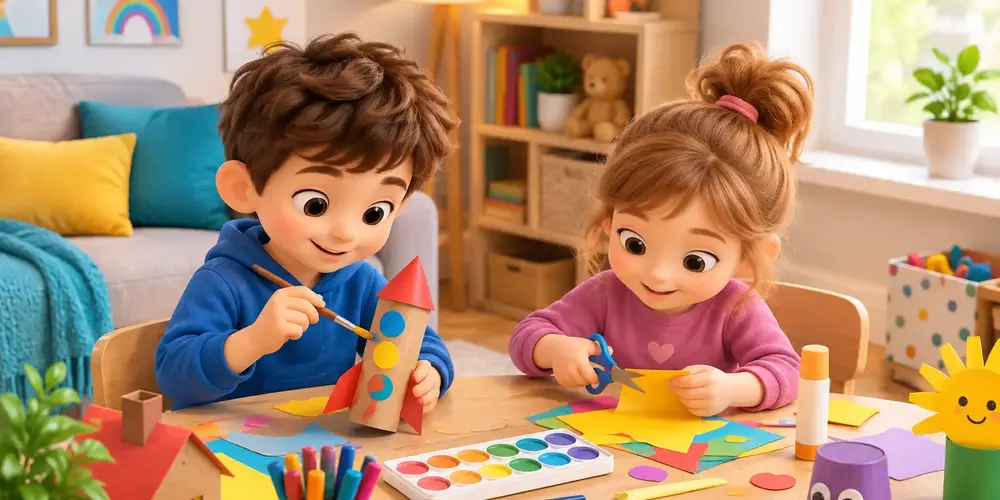
A rainy afternoon, the child is tired of screens, and parents don't have time to prepare a complex project - these are exactly the situations when the best creative activities for children at home come in handy. They don't require expensive sets or a special workshop. A few available materials, clear instructions and a place where it's okay to get a bit messy is enough.
Creative activities for a child are not just a way to fill free time. They develop finger dexterity, attention, the ability to choose and complete what has been started. For parents, the most important thing is not to achieve a neat result, but to give the child an opportunity to try things themselves, make mistakes and find their own solution.
How to prepare a space for creative work
Before choosing an idea, it's worth tidying up the workspace itself. Lay an easy-to-clean mat or old paper on the table, place wet wipes and a container for scraps nearby. If materials are in one box or basket, the child can start work more independently and then participate more easily in tidying up.
A practical home supply includes coloured paper and cardboard, pencils or felt-tip pens, glue, child-safe scissors, stickers, plasticine and various decorations. With this foundation, you can create dozens of works by changing only the theme. For example, one day an animal is created, another day - a greeting card or a toy shop display.
You don't need to present all the materials to the child at once. For younger children, too much choice sometimes makes it difficult to start. Offer two or three materials and one simple question: "What can we make from circles today?" or "What would your imaginary castle look like?"
The best creative activities for children at home for different ages
One and the same idea can have a different difficulty level. A three-year-old can tear paper and glue large pieces, but a school-age child can create a specific picture from them, add a background and make up a story. This approach is convenient for families with several children - everyone works on one theme, but each at their own level.
Torn paper collage without complications
Paper tearing is simple, safe and develops hand coordination well. Draw a large outline on cardboard - a fish, tree, cloud, house or animal. The child tears the coloured paper into small pieces and fills the shape with glue.
For younger children, it's better to choose large outlines and prepare a few colours in advance. For older children, you can add the task of creating patterns, shadows or a background. The result can also be used practically - as a room decoration, a bookmark or a card for grandparents.
Plasticine pictures and small figures
Plasticine allows you to work without the requirement to draw precise lines. Start with balls, sausage shapes and flat shapes, then create flowers, snails, fruits or imaginary characters from them. To make it easier for the child, you can draw a simple picture on cardboard and invite them to fill it in with plasticine.
An interesting variation is a "plasticine café". The child creates food on toy dishes, prepares a menu from paper and takes orders. Here the creative work becomes a game, where speech, counting and the ability to agree on roles also develop.
Homemade cards with a purpose
Card making becomes more engaging for a child if it has a specific recipient. It can be a birthday card, thanks to a teacher, a wish to a friend or simply a letter to a relative. Cardboard, stickers, ribbons, coloured paper and drawings provide plenty of opportunities without turning the work into a too complex project.
There's no need to correct every uneven letter or crookedly stuck detail. If the child chooses the colours themselves and writes a few words, the card gains the main value - it is personal. If the child can't write yet, the adult can write down what the child said exactly as it sounded.
Drawing with a task, not a blank sheet
A blank white sheet brings joy to some children, but for others it seems like too much choice. Then a specific task helps: draw a vehicle of the future, a map for a road to treasure, your dream room or an animal that hasn't been discovered yet.
You can also use a dice. One number is assigned a figure, another - a place, yet another - an object. For example, a child needs to draw a bear in space with an umbrella. There is no right answer here, and that is often what engages children who usually say they can't draw.
Toy shop from everyday items
A toy shop is a suitable option if you want to combine crafts with role play. You can make price tags, shopping lists, money and a shop name from paper. Empty, clean packaging boxes can become goods, whilst a small basket can become a shopping trolley.
This activity works particularly well with two or more children. One can be the shop assistant, the other the customer, and then they swap roles. A parent can get involved only at the beginning, helping to prepare materials, and let the play continue on its own.
Creativity from the season and household supplies
Natural materials are a good addition to paper and paints. In autumn, leaves, twigs and pine cones come in handy, and in spring - petals and small stones. Before use, dry them and check that they are safe for the child. Small parts are not suitable for children who might swallow them.
Animals can be made from leaves, small frames from twigs, and figures from pine cones and modelling clay. The advantage of such work is that the child first collects the materials themselves. A walk becomes part of the activity, rather than just time before it.
Things available at home can also be reused: toilet paper rolls, egg boxes, paper bags and cardboard packaging. However, you shouldn't keep everything. Keep a few clean, durable materials and give the rest for recycling. Otherwise, the creative corner quickly turns into a pile of messy boxes.
When to help and when to step back
The adult's main task is to provide a start, not to take over the work. If the child asks for help, show one technique - how to use less glue, how to fold cardboard or how to hold scissors safely. Then hand the work back to the child.
It is normal if the child doesn't finish the work. Sometimes fifteen minutes is enough, especially for preschool age. Keep the started work in a folder or box and offer to return to it another day. Pressure to complete each project often reduces the desire to start the next one.
Mess is also part of the process, but it needs boundaries. Agree that before the next idea, papers are tidied up, glue is closed and pencils are put away. The child gradually learns that creative work involves not only creation, but also caring for their materials.
How to maintain interest for longer
You don't need to offer a new technique each time. Children often like to repeat one activity until they can do it confidently. If drawings with stickers are the focus this week, next time just change the theme: an underwater world, a farm, a city or a festive table.
A small work folder or box is also useful. It allows the child to see what they have already created and provides material for conversation. Instead of evaluating with "beautiful" or "correct", ask: "Which part was the most interesting to make?" or "What would you do differently next time?" These questions promote thinking far more than a ready-made example.
Creative activities at home don't need to be perfect, lengthy or carefully planned. If the necessary materials are at hand and the child has the freedom to choose, an ordinary evening can turn into work that they truly take pride in.