Guests often notice practical details rather than expensive interiors: whether there is somewhere to put their luggage, whether a clean towel is within easy reach, and whether they can use a power socket without moving furniture.
The question of how to organise guest room amenities is therefore not merely about décor. It is about creating a clear, repeatable system that helps guests feel comfortable while enabling the business to keep costs under control.
This applies to guest houses, short-term rental apartments, hostels, country houses and small accommodation establishments. The same principle also applies to a guest room at home: every item should be useful, clean and easy to find. There is no need to fill the room with random objects that merely take up space.
Start with How the Guest Room Will Be Used
Before ordering any supplies, determine who the room is intended for and how long guests usually stay. For an overnight guest, the priorities are sleeping comfort, hygiene and a convenient place to charge a phone. Guests staying for several days will also need space for their clothes, extra hangers, a waste bin, a mirror and a suitable surface for their personal belongings.
The room category will also affect what should be provided. In budget accommodation, it is better to offer fewer items while keeping them tidy and consistent across all rooms. A larger family room will require more towels, an extra blanket, chairs and space for luggage. For business travellers, a desk or small work surface, good lighting and an accessible power socket are particularly useful.
It is practical to establish one standard set of amenities for every room. This means staff do not have to determine what is missing each time, and purchasing lists become easier to manage. A standardised set also makes it simpler to replace damaged or missing items.
How to Organise Guest Room Amenities Without Unnecessary Expense
Amenities should be arranged by zone rather than placed wherever space happens to be available. This reduces questions from guests and makes housekeeping easier. The bedside area should include a reading lamp, a small table or shelf and an accessible power socket. Near the entrance, it is useful to provide a coat hook or rail, a mirror and somewhere for shoes or luggage. If the room has a wardrobe, it should contain enough hangers—not just a single decorative one.
In the bathroom or shower area, items should be positioned so that guests can reach them with clean, dry hands. Towels should not be kept too close to the floor or a wet shower area. A soap dish, liquid soap dispenser, toilet roll holder and small waste bin are simple additions that create a tidy, well-maintained impression.
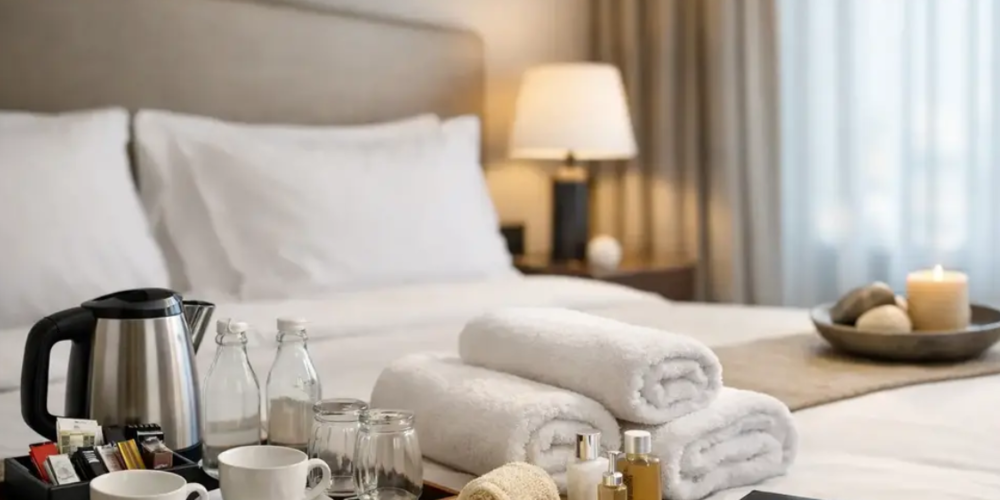
A basic guest room set will usually include:
-
clean bed linen, pillows, a duvet or blanket, and an additional blanket for colder weather;
-
two towels per guest, plus a bath mat if the room has a shower;
-
hangers, a mirror, a waste bin and a small area for personal belongings;
-
soap or a liquid soap dispenser, toilet paper and sanitary disposal bags;
-
drinking glasses, a small information card and accessible power sockets.
There is no need to expand this list with every possible extra. Slippers, sewing kits, shoe-care products and single-use toiletries can be useful, but they should be selected according to the guest profile and room rate. If these amenities are rarely used, they increase inventory costs and create additional work for housekeeping staff.
The Bedside Area: Prioritise Sleep, Not Clutter
The bed is the main feature of the room, so cleanliness and sufficient replacement stock are not areas in which to cut corners. It is advisable to keep at least two sets of bed linen for every bed—one in use and one being laundered or kept in storage. Properties with higher occupancy should have an additional spare set to ensure that fresh linen is available when an unexpected change is required.
Place only genuinely useful items beside the bed: a lamp, a power socket and a small surface for a phone, glasses or a drinking glass. Where there is no bedside table, a wall-mounted shelf is a practical solution. It takes up little space and is easier to maintain than a large piece of furniture.
Additional pillows and blankets should not be left uncovered on top of a wardrobe or chair. Store them in a clean, dry cupboard or a closed storage box. Guests should be able to tell that the textiles are clean, rather than merely arranged to look tidy.
Hygiene Amenities: Provide Less, but Replenish Regularly
Guests form an impression of bathroom amenities very quickly. An empty soap dispenser, a damp towel or an insufficient supply of toilet paper creates a worse impression than a simple interior. Hygiene products should therefore be included in the room inspection checklist after every cleaning.
Larger liquid soap dispensers are often more economical than individual miniatures or sachets. They reduce packaging waste, are easier to refill and make consumption easier to control. Single-use products, meanwhile, may be appropriate where hygiene requirements or the accommodation concept call for them. The right choice depends on guest turnover, housekeeping procedures and budget.
Choose towels in consistent sizes and neutral colours so that they are easy to sort, wash and replenish. Very thin towels wear out more quickly, while very thick towels take longer to dry and may increase laundry costs. For everyday use, a medium-weight material that retains its shape after repeated washing is usually the most practical option.
Organise Stock So That Supplies Do Not Go Missing
Guest room supplies will only remain cost-effective if the storeroom has a clear and transparent system. Keep an inventory of essential items, including towels, bed linen, soap, paper products, drinking glasses, hangers and bin liners. If the property has only a few rooms, there is no need for complicated software. A simple spreadsheet showing the current quantity, minimum stock level and next order date is enough to begin with.
It is also useful to prepare housekeeping kits for individual rooms. For example, one box or shelf can hold the correct quantity of towels, hygiene products and bin liners required for a single room. Staff take the kit, record what has been used after cleaning, and any shortage becomes immediately visible. This approach reduces both excessive consumption and situations in which guests have to request basic items at reception.
When purchasing supplies, give preference to products that can be reordered regularly in consistent quality. If every delivery contains a different shade of towel, glass size or dispenser type, rooms soon become inconsistent and stock management becomes more complicated. The Lutini.lv range is a practical place to find widely used hotel and household supplies that can be ordered together with other everyday essentials.
Inspect the Room from the Guest’s Perspective
Once the room has been arranged, enter it carrying a bag and act out the first five minutes of a guest’s stay. Is there somewhere to put the keys? Is it obvious where to hang a jacket? Is there a clear path to the bed? Are the towels and soap easy to find in the bathroom? This simple test reveals problems that may go unnoticed by someone who sees the room every day.
Wear and tear should also be reviewed regularly. Yellowing pillows, scratched glasses, broken hangers and unstable bin lids should be replaced before they fail completely. Small, timely replacements help a room remain tidy and well maintained without requiring major investment.
The best set of guest room amenities is not the one containing the greatest number of items. It is the one in which everything a guest needs is clean, accessible and works exactly when it is required.