
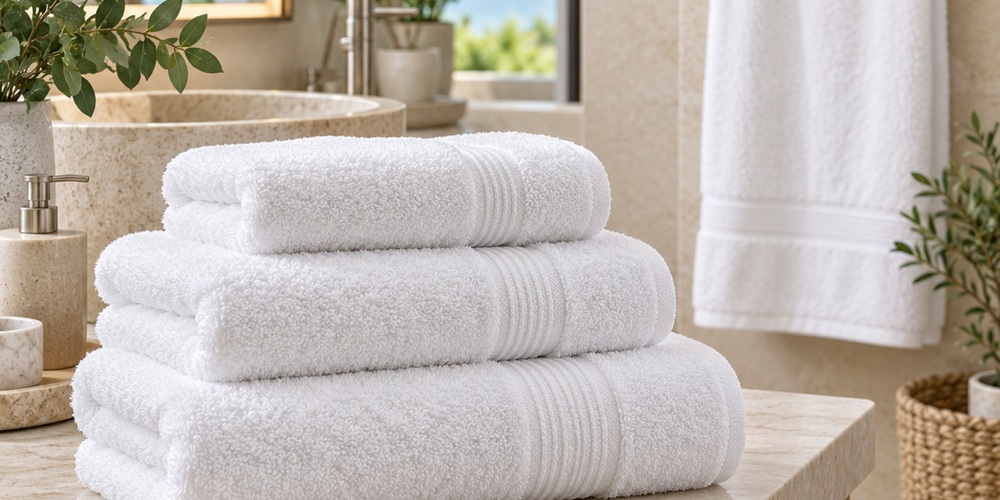
When choosing towels for a hotel, several important aspects must be taken into account. The most important criteria are water absorbency, softness, durability, maintenance costs and the ability to replenish stocks regularly.
Material and water absorbency
The main function of a terry towel is to dry the skin, so water absorbency determines how well the towel performs its task. If the towel absorbs moisture poorly, it must be used repeatedly to dry the skin.
The more synthetic fibres, such as polyester, in the towel's composition, the weaker its absorbency usually is. For example, with a 100% fleece towel, it can be difficult to dry oneself because it absorbs moisture poorly. For hotels, the best and most skin-friendly choice is usually 100% cotton.
Softness and loop length
The softness of a terry towel is determined by both the material and the fabric structure. The loop length on the towel's surface is particularly important. The longer the loops, the softer the towel usually is and the better it absorbs water.
However, very long loops can easily catch on jewellery or other sharp objects, causing damage. On the other hand, very short loops absorb moisture poorly. Therefore, the most practical solution is a 100% cotton towel with medium-length loops — this provides a good balance between softness, absorbency and durability.
White or coloured towels?
Hotels most commonly use white towels. On a white towel, you can immediately see whether it is clean, and in the laundry it is more efficient to process textiles of one colour together. White towels also create an impression of cleanliness and consistent standards.
Some hotels and especially spa facilities choose coloured towels to highlight their interior design or brand style. Towels with borders, patterns and other decorations are also available. However, additional decorative elements can behave differently from the terry fabric itself during washing, change the towel's shape, make the edges uneven or shorten its lifespan.
Check durability before placing a large order
A hotel's goal is to use towels for as long as possible. Over two to four years, a single towel can be washed 100–300 times. Problems may not be visible after a single wash, but regular professional washing significantly tests the fabric, seams and decorations.
Before a large purchase, it is worth asking the supplier for one sample and washing it at least five times. It is even safer to perform 30 washing cycles to assess how the towel maintains its shape, colour and softness over the long term.
Colour fastness
A large proportion of the coloured towels available on the market are manufactured using the reactive dyeing method and are designed for washing at temperatures up to 60 °C. However, even at such a temperature, the colour will gradually fade over time.
If particularly good colour fastness is required, towels dyed using VAT-dye technology can be chosen. These typically cost approximately 30% more, so they are not as widely distributed. Batches of coloured towels purchased in different years may vary visually, and this should be taken into account if the hotel wishes to maintain a completely consistent shade.
Stock replenishment and supplier selection
If a special design has been chosen, the hotel must plan regular stock replenishment. A very specific model may no longer be available after some time, and then it becomes necessary to use different towels or completely replace the entire set.
Standard white hotel towels are easiest to replenish. By working with an experienced supplier who has offered the same model for a long time, there is a greater chance of maintaining consistent fabric structure, loop length and design.
Hotel logo on the towel
A hotel logo on a towel can be created in several ways. It is possible to add an embroidered logo to a towel in stock. You can choose one colour for the towel and logo or use a contrasting shade.
A very large embroidery across the entire towel surface can be disproportionately expensive. If a large logo is required, it is more economical and technically appropriate to incorporate it during the towel manufacturing process.
Towel losses in the hotel
The more attractive and expensive the towel, the greater the chance that a guest will want to take it as a souvenir. Terry towels are one of the most commonly missing items in hotels.
If the towel has the hotel's logo on it, it can serve as a small advertisement and reminder of the hotel. However, in practice, beautiful, coloured and personalised towels tend to go missing more frequently, so these costs should also be included in the overall calculation.
Which fabric weight to choose?
Fabric weight is indicated in grammes per square metre. Hotel terry towels most commonly use weights from 400 to 600 g/m². Towels weighing less than 400 g/m² are usually too thin for intensive hotel use.
Luxury hotels often choose 550–600 g/m² towels. These are thicker, softer and provide a more pronounced comfort sensation. In contrast, a 400 g/m² towel is a practical standard solution — it provides good absorbency and softness whilst maintaining a reasonable price, faster drying and lower washing costs.
Standard hotel towel sizes
|
Size |
Recommended use |
|
30 × 30 cm |
Face towel |
|
50 × 70 cm |
Hand towel or bath mat |
|
50 × 100 cm |
Larger hand towel |
|
70 × 140 cm |
Bath towel; 70 × 150 cm is also often used |
|
100 × 200 cm |
Terry cloth throw or massage table cover |
Shrinkage during washing
When planning sizes, it should be borne in mind that towels may shrink during washing. Shrinkage in width is typically around 1–2%, whilst in length it is 5–10%. Therefore, the size should be evaluated not only for a new towel, but also after several washing cycles.
Practical towel set for a hotel room
A standard hotel room typically includes two hand towels, two bath towels and two bath mats. Luxury hotels often supplement the set with 30 × 30 cm face towels.
Conclusion
A safe and practical choice for a hotel is a 100% cotton terry towel with medium-length loops. A weight of approximately 400 g/m² is suitable for a standard hotel, whilst for a higher comfort segment — 550–600 g/m². White colour simplifies washing, replenishment and quality control. Before placing a larger order, test samples through several washing cycles and evaluate not only the initial price, but also durability, maintenance costs and future availability.
Additional information and hotel towel offer: TOWELS


