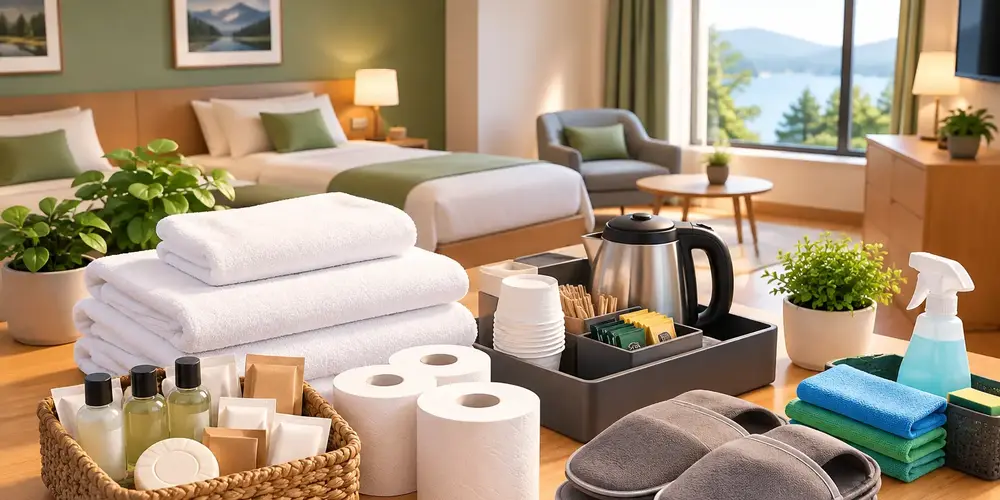
A guest house visitor first notices not the interior, but practical things: whether there is a clean towel, the soap dispenser works, there is no shortage of toilet paper, and the kitchen is convenient for preparing breakfast. Therefore, the question of what products to buy for a guest house is not just about furnishing the premises. It is about a stock system that helps maintain the same quality for each guest and avoids urgent purchases in the middle of the season.
A guest house typically needs two product groups. One is visible to the guest - textiles, hygiene products, kitchen items and small comfort items. The other remains in the utility room - cleaning products, refuse bags, spare bulbs, batteries and other everyday necessary items. By planning purchases together, it is easier to order sufficient quantities and monitor stock levels.
What products to buy for guest house rooms
Room equipment must be simple, durable and easy to replenish. Each room does not need complicated decorations, but must not lack things that a guest expects without asking. The more rooms a guest house has, the more important it is to choose identical or mutually compatible products. Then replacement and reorder will be faster.
Bed linen and towels
Textiles are one of the largest regular expenses. One set per bed is not enough. Stock is needed so that you can change the linen after each booking, wash the used textiles and at the same time prepare the next rooms. It is practical to keep separately organised sheets, duvet covers, pillowcases, large bath towels, hand towels and kitchen towels.
When choosing textiles, you should not only look at the initial cost. Very thin fabric wears out faster, whilst complex patterns can make it difficult to replenish identical stock. Neutral colours and simple sizes help maintain order in the warehouse. If the guest house has family rooms, bedding suitable for children's beds and extra blankets are also useful.
Small items that create a sense of order
A guest will benefit from coat hangers, a waste bin, a small mirror, a fabric or plastic basket for small items and an information folder with the guest house rules. If there is a table in the room, add a table lamp or other convenient lighting. In places where families often stay, solutions suitable for child safety and non-slip mats are useful.
It should be remembered that small items tend to go missing or break more often than furniture. Therefore, it is better to keep a small reserve of coat hangers, mugs, remote control batteries, bulbs and waste bins, rather than looking for them when the next guests have already arrived.
Bathroom stock without shortages
A clean and fully equipped bathroom significantly affects guest reviews. Basically, toilet paper, liquid soap, hand towels, bath towels, refuse bags and a toilet brush are needed. If you offer a shower, add a shower curtain or the products needed to clean glass areas, as well as a non-slip mat.
Single-use hygiene products - toothbrush, toothpaste, shaving kit, shower cap or slippers - are not mandatory in every guest house. They are useful if you want to offer extra convenience or accommodate guests who arrive late and travel without luggage. In a smaller accommodation, these items can be kept at reception or in the utility room and issued upon request. This helps reduce unnecessary consumption.
Dispensers are usually more practical than many small packages if they are regularly cleaned and refilled. On the other hand, small individual packages may be more suitable in places where quick room preparation or a specific service standard is important. The choice depends on guest flow, staff time and your guest house's operating model.
What is needed for the kitchen and breakfast area
If guests have access to a shared kitchen, the product list becomes wider. Plates, bowls, mugs, glasses, cutlery, pans, pots, chopping boards, knives, strainers and kitchen towels are needed. Before placing an order, count not only the number of beds, but also the maximum number of people who can use the kitchen at the same time. The quantity of dishes must be sufficient for full occupancy and one reserve.
In the breakfast area, you need napkins, paper towels, sugar bowls, tea and coffee accessories, serving trays, waste bins and food storage containers. If buffet-style breakfasts are offered, also consider labels, tongs, spoons and dishes for jam, butter or other products.
Disposable crockery is not the first solution for daily guest reception, as it generates more waste and needs to be replenished regularly. However, it can be useful at events, in outdoor areas or situations where a larger number of guests is expected. It is best to keep them as a backup option, rather than building all kitchen work around them.
Cleaning products are essential for continuous operation
A guest house cannot rely on one universal cleaning product. Different surfaces and spaces require appropriate care. Products are needed for the bathroom, kitchen, floors, glass and furniture, as well as disinfectants for high-touch areas. Additionally, sponges, cloths, microfibre rags, gloves, brushes, mops, buckets and paper towels are required.
It is worth dividing cleaning equipment by zones. For example, bathroom brushes and cloths should not be used on kitchen surfaces. Colour coding helps staff quickly understand what each item is intended for. Such organisation is particularly useful for seasonal workers or when several people are involved in cleaning.
Do not forget about laundry detergents, stain removers, descalers and appropriate bags for dirty laundry. These products often run out unexpectedly, as consumption increases with occupancy. Store them in a dry, closed place and check stock levels regularly.
Reserves and safety products
Good guest house purchasing does not end with daily consumption. A small reserve is also needed for unforeseen situations. This can include batteries for smoke detectors and remote controls, light bulbs, extension leads, tape, scissors, sewing accessories, umbrellas, spare key rings and first aid kit refills.
If the guest house has outdoor areas, additional needs arise in season: insect repellent, lanterns, napkins, outdoor waste bags, picnic accessories or children's toys. These products do not need to be stored in a visible place all year round, but should be checked and ordered in time before the busy season.
How to create a shopping list and control stock
It is most convenient to divide products into three levels: daily consumption, regularly replenished reserves and seasonal products. Daily consumption includes toilet paper, soap, waste bags, cleaning products and paper towels. Regular reserves include textiles, crockery, light bulbs and equipment. The seasonal category includes festive decorations, outdoor items, gifts and event accessories.
Set a minimum stock level for each important product. For example, an order should be placed not when the last package remains on the shelf, but when the stock is no longer sufficient until the next delivery and expected occupancy. A simple table with product name, stock level, storage location and order frequency already provides good control.
By purchasing a wide range of household, textile, kitchen and guest supplies products in one place, the time spent on various small orders is reduced. The Lutini.lv range can be a practical resource if you need to replenish several product categories in one purchase and check available stock levels.
Start with one unit as a sample: prepare it completely, record every product used and then multiply the quantities by your actual occupancy. This will create a shopping list based not on guesswork, but on your guest house's daily operations.