
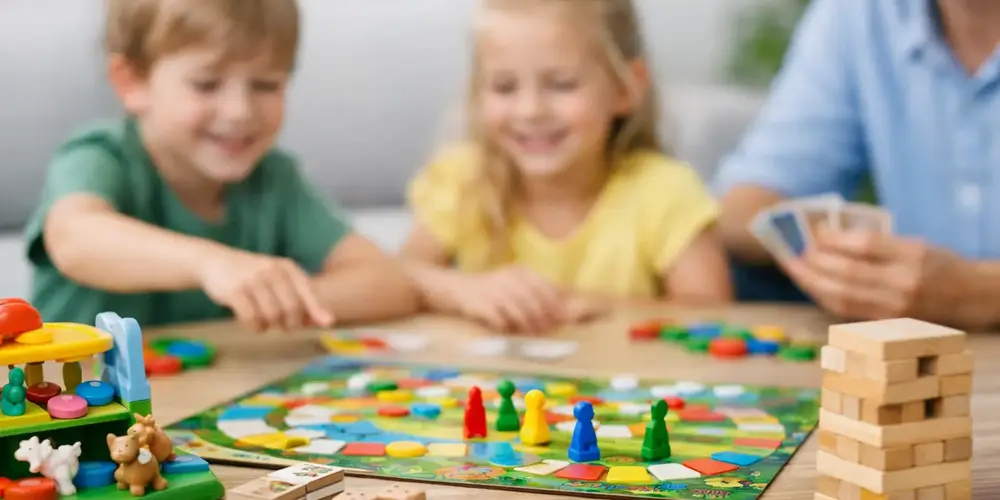
When looking for children's board games cheaply, the main question is not just about price. It is important to understand whether the game will be understandable to the child, durable enough and age-appropriate, so that the purchase is actually used rather than left on the shelf after one go. This is exactly why a cheap choice does not always mean a random choice.
Parents, gift buyers and small traders alike usually look for the same thing - an affordable price, clear content and a product that can be bought quickly without lengthy comparison. In the board games category, this is especially relevant because the selection is wide, but the quality and complexity level can vary greatly.
How to tell if a cheap board game is a good purchase
A low price in itself is not a drawback. Many simple games for children are cheap precisely because they have fewer parts, simpler rules and more compact packaging. This is often a plus, not a minus, especially for preschool and younger school-age children.
Attention should be paid to what the child actually expects from the game. If you need quick, easy entertainment for the family for an evening, there is no need for a complex set with dozens of elements. On the other hand, if you are buying a game as a gift or for longer use, it is worth looking to make sure the rules are not too simplistic and the game does not lose interest after a few plays.
From a practical perspective, a good purchase at a lower price usually means three things - an appropriate age group, understandable mechanics and normal material quality. Cardboard elements can be thinner, packaging simpler, but the game should still be playable and transparent.
Board games for children cheaply by age
Age is the first filter worth using. If it is not respected, even a good price cannot save a failed purchase.
3-5 years
At this age, games with colours, shapes, picture recognition and simple sequences work best. The child does not yet need long rules or complex strategy. It is better to choose a game that can be started almost immediately.
Cheap games in this group are often very appropriate, because what matters most is not the number of details, but a clear task. Picture dominoes, memory games, simple logic cards and dice games often give good results on a small budget.
6-8 years
Here, children are already able to follow rules, wait for their turn and understand simple scoring principles. So you can look at games with a small competitive element, tasks or movement across a board.
In this group, it is important that the game is not too short or too childish. If the game looks good but the content is too simple, interest quickly fades. If it is somewhat challenging, the child will use it longer.
9+ years
For older children, cheap board games are still a good option, but the choice becomes more sensitive. They quickly notice repetition, predictable moves and poor design. At this age, the cheapest option will not always be the most worthwhile.
It is better to look for games with strategy, questions, reaction speed or a small team element. Even if the price is low, the game must be dynamic enough for the child to return to it.
What determines price and where differences arise
Buyers often compare prices, but do not always look at why one game costs less than another. The difference usually comes from the package contents, brand, packaging size and quality of parts.
Simpler games with cards, tokens or a small board are cheaper to produce and also more cost-effective in the final purchase. More expensive are usually games with plastic elements, large boards, multiple figures or licensed themes. This does not mean that the more expensive one will be the most suitable for the child.
If the purchase is made practically rather than impulsively, it is more cost-effective to look at the usefulness of the game. Can it be played by multiple children? Can it be used repeatedly? Are the rules understandable without lengthy explanation? These factors actually affect the real value more than bright packaging.
When to choose a very cheap option and when not to
There are situations where a very cheap board game is perfectly adequate. For example, for a small gift, children's party prizes, a seasonal offer in a shop or as an additional purchase along with other items. Also, if the child likes to change activities frequently, there is no point overpaying for a complex set.
On the other hand, if the game is intended for regular use in the family, nursery, play room or for resale in retail, a more careful look is needed. Material that is too thin, unclear rules or easily lost parts can cause more inconvenience than savings.
A simple principle works here - the more intensive the use, the more important durability becomes. For one-off or irregular use, a more economical option is sufficient. For everyday use, it's better to look at a balanced option.
What to check before purchasing
So that board games for children bought cheaply are truly a successful purchase, you should check more than just the price before ordering. This is especially important if you're buying several pieces or choosing for resale.
First, you should look at the recommended age. This helps avoid situations where the game is too complicated or too simple. Next, it's worth paying attention to the number of players. Some games work well only for two, whilst others are suitable for the whole family or a group of children.
It's also useful to check the contents of the set. If a game with many small elements is offered at a low price, you should assess whether they will be practical to use. If the child is younger, games with larger pieces are often safer and more convenient.
If the purchase is related to resale, you should evaluate not only the product itself, but also how easily it can be explained to the buyer. Simple, understandable games with a clear objective often sell more steadily than specific or difficult-to-describe sets.
A practical approach for families and traders
For a private purchase, the child's interest and price are usually most important. People often look for one or two games to add to a gift, leisure time or rainy days at home. In such cases, the main thing is not to overpay and not to choose too complicated an option.
For small traders and buyers who put together a wider range, the situation is somewhat different. What matters here is whether the product is universal, whether it suits different age groups and whether the price allows you to maintain an attractive final offer. Children's board games in the lower price segment often work well precisely because they are easy to understand and suitable for impulse buying.
The warehouse assortment approach of the Lutini.lv type is convenient here because you can combine several categories in one order - toys, gifts, stationery and seasonal items. This is practical both for families who want to buy more at once and for sellers for whom time and simple stock replenishment are important.
Most common mistakes when buying cheap board games
The most common mistake is buying based on packaging rather than contents. Bright design creates the impression that the game will be interesting, but in reality the rules can be very limited. The second mistake is to ignore the age indication, hoping that the child will "grow into the game". Sometimes this happens, but often the game simply remains unused.
Another mistake is to expect premium quality from the lowest price segment. If the price is very low, you should accept that the packaging and materials will be simpler. If you take this into account from the start, disappointment will be less and the choice more accurate.
It's also useful to remember that not all children's games are designed for quiet, prolonged play. Some of them are short, quick and designed for a short attention span. This isn't a drawback if that's exactly the type of use you need.
How to find a good price without excessive searching
If the goal is to buy quickly and affordably, a clear filter helps. First, determine the child's age, then the budget and only then choose the type of game. This order saves time and reduces spontaneous purchases that don't pay off later.
There's no need to complicate the purchase. Often the simplest games are the ones children use the most because they can start without lengthy preparation and be played repeatedly. If the price is accessible, the rules are understandable and the game suits the age, that's already a good deal.
If you're looking for children's board games cheaply, the most valuable thing isn't finding the cheapest box. The most valuable thing is finding an option that the child will actually open again.