
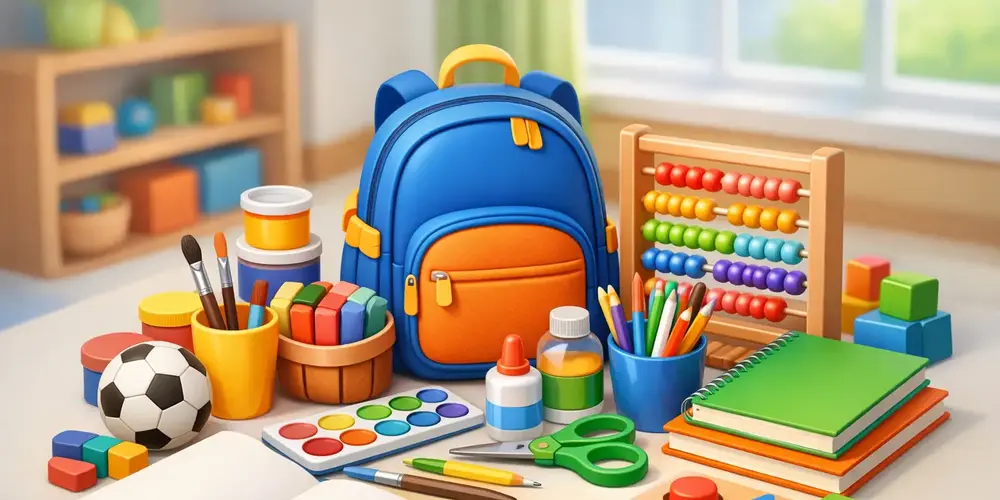
A nursery needs list usually starts with a few pencils and paints, but quickly becomes longer. One group regularly needs supplies for creative activities, first writing steps, celebrations and daily routines. That's why school supplies for nursery are better planned as a replenishable stock rather than one large purchase before the new school year.
A practical choice means not only finding what you need, but also assessing what will actually be used. For a group teacher, a safe and easy-to-use product is important; for parents—a clear list; and for the person making purchases—available quantities, simple ordering and the ability to buy different categories in one place.
School supplies for nursery start with daily essentials
Before choosing decorative materials or thematic sets, essential items must be secured. These are consumed fastest and are usually needed in every age group. Pencils, coloured pencils, markers, erasers, sharpeners, scissors, glue, paper and cardboard are a regularly replenished stock.
For the youngest children, the choice should be tailored to hand dexterity. Thicker crayons and pencils are easier to grip, but scissors should have rounded ends. Glue comes in useful packaging that a child can open and close without extra help. Such details reduce both mess and the time a teacher spends on minor technical issues in daily work.
Older groups more often use regular and coloured pencils, rulers, simple workbooks and stickers. However, there is no need to buy complex office supplies just because they look professional. In nursery work, preference is for ease of use and the ability to quickly replace a used or lost item.
Creative work needs a material reserve
Creative work consumes materials unevenly. One week requires a lot of coloured paper, another—plasticine, ribbons or glue. If purchases are only made when a particular material runs out, the lesson plan may need to be changed at the last minute.
It is useful to keep reserves of several basic material groups:
- white, coloured and thicker paper;
- cardboard in various colours;
- plasticine or modelling clay;
- gouache or watercolour paints, brushes and water containers;
- tape, glue sticks, decorative stickers and ribbons;
- bags and boxes for storing natural materials or small items.
Balance is important here. Cheaper paper for everyday drawings can be a good solution, but collages, painting with wet paints or greeting cards will need a thicker base. Brushes don't have to be the same either—a wide brush is useful for backgrounds, but a thinner one for details. By buying a few practical options, you don't need to buy a large and rarely used set.
Leftover materials don't need to be thrown away immediately. Smaller cardboard pieces are suitable for applications, labels or games, while ribbons and stickers can be used for holiday decorations. However, small items should be stored in separate containers with labels. Otherwise, the stock seems lost, even though it's actually in several drawers.
Writing and pre-school skills
School supplies for nursery aren't just creative activities. In pre-school, children learn to draw lines, distinguish shapes, arrange pictures and gradually train their hands for writing. Work sheets, notebooks, pencils, erasers, stencils, number and letter cards are useful for this work.
If supplies are purchased for a group, it's worth choosing a simple system. For example, each child can have their own pencil set or a marked box of supplies, while shared materials are stored on an accessible shelf. An individual set helps reduce quarrels and makes daily preparation easier. A shared stock is economical for items like glue, scissors or paints, which don't need to be individual for each child.
Stickers, stamps and small rewards can be useful auxiliary materials rather than main teaching aids. They are used to mark completed work, organise children's belongings or make a task more understandable. Too many bright elements sometimes distract attention, so it's better to choose ones that have a specific purpose.
How to plan purchases for a group or the entire facility
Purchasing for one group and multiple groups differs mainly in planning accuracy. For a larger order, you first need to find out the number of children, age groups, existing supplies and upcoming events. Autumn, Christmas, Mother's Day and graduation often require extra decorations, packaging materials or craft supplies.
A good solution is to divide needs into three parts: daily consumption, seasonal activities and emergency stock. Daily consumption includes paper, glue and writing supplies. Seasonal purchases relate to holiday decorations or specific creative work ideas. Emergency stock protects against situations where cardboard, paint or scissors run out just before a lesson.
When ordering in bulk, you shouldn't automatically choose the largest pack size. This is economical for items with stable consumption, such as A4 paper or glue sticks. However, specific decorations, certain colour ribbons or seasonal stickers may remain unused if bought in too large quantities. The most practical amount is what can be easily stored and used within the expected time.
On Lutini.lv you can conveniently combine office supplies, creative materials, small gifts and seasonal items in one order. Buyers should check product codes, stock availability and package quantities, especially when supplying multiple groups or planning regular top-ups.
Safety, storage and organisation
Nursery supplies must be suitable for children's age. Small parts, sharp instruments and materials with specific use should be under adult supervision. When purchasing paints, plasticine or glue, attention must be paid to the intended use and labelling.
Storage is equally important. Clear plastic boxes help you see the contents at a glance, while labels on boxes speed up material retrieval. Daily supplies, seasonal decorations and teacher's work materials can be stored separately. An organised stockroom or cabinet allows you to understand actual stock levels rather than buying duplicates just because the needed item isn't easy to find.
After each major creative activity or event, a brief stock check is useful. Note what runs out, what is used rarely and what children use particularly often. A few minutes of record-keeping helps you buy purposefully in the next order rather than guessing.
A nursery supplies list doesn't need to be complicated. If basic materials are available, supplies are stored clearly and frequently used items are in reserve, a teacher can spend more time on lessons rather than hunting for missing glue or paper at the last minute.