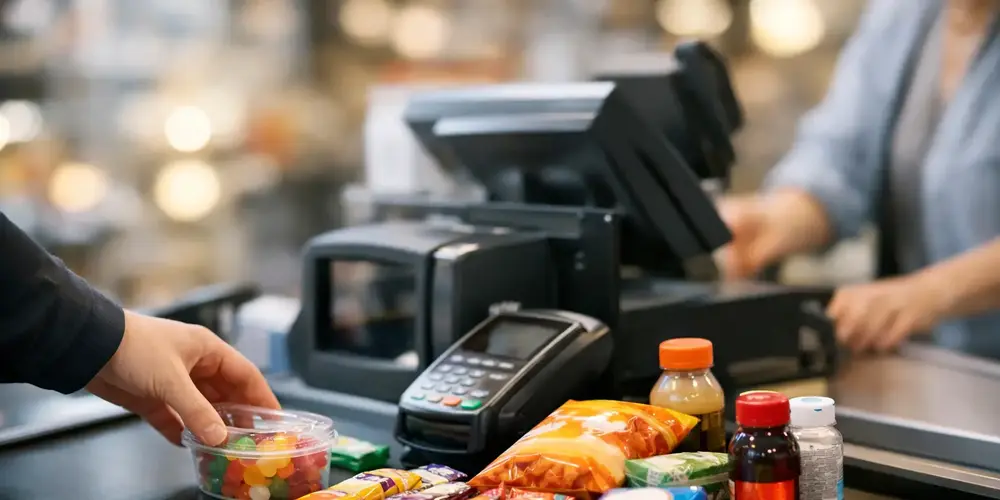
The customer has already chosen the main item, is standing in the queue and waiting to pay. It is precisely at this moment that impulse purchase items at the checkout can add one or two more small units to the basket. In retail, this is not a random shelf at the checkout, but a practical way to increase the average purchase amount with products that are easy to notice, understand and buy without lengthy comparison.
The checkout zone is limited, so the assortment must be selected precisely. There is no room here for products with complex selection, large packaging or unclear application. Products that work best are accessible, useful for everyday use or suitable for a small gift, whose price seems reasonable to the customer even as a spontaneous purchase.
Why impulse purchase items work at checkout
At the checkout, the customer's attention is no longer divided between a large number of shelves. He has already made the decision to buy, and a small addition to the basket does not require the same consideration as the main purchase. The clearer it is what the product is intended for and how much it costs, the less hesitation there is.
The size of the product is also important. Small hair tie sets, pens, notepads, key chains or seasonal decorations are easy to pick up and put in a bag. Such products do not take up much space at the checkout and allow you to display several price points in one area.
However, impulse assortment is not universal. Products suitable for a grocery store checkout may not work at a gift, toy or household goods trading venue. The choice should be based on customer flow, their main purchases and the price level in the shop. If a customer comes in for cheap everyday items, too expensive an accessory at the checkout may go unnoticed.
What products to choose for the checkout zone
A good checkout product usually meets three conditions: it is compact, understandable at first glance and available at a low or medium price. Ideally, the product should be useful immediately or easy to give as a gift. The customer should not have to look for additional information, consult staff or buy batteries that are sold at the other end of the shop.
For a practical mixed goods shop, the following categories are useful:
- hair accessories, hair ties, clips, combs and small cosmetic pouches;
- pens, pencils, stickers, notepads and other stationery items;
- key chains, small jewellery, bracelets and decorative accessories;
- small toys, stress relief products, bubble blowers and travel games;
- seasonal small items, such as festive decorations, sunglasses, rain ponchos or gift wrapping accessories.
You don't need to display everything possible in one checkout zone. Too wide and colourful an offer can have the opposite effect - the customer doesn't choose anything because it's unclear what to focus on. Start with a few clear categories and add to them based on sales data.
Products that customers can buy in multiple units work particularly well. Hair ties, stickers, pens or small gifts are often bought not one at a time, but two or three. This is also a good solution for traders who want to offer cheap products with a clear mark-up opportunity.
Price is as important as the product itself
A product without a price at the checkout often becomes an unsold item. The customer does not want to hold up the queue by asking about the cost of each small item. The price tag should be large, simple and placed next to the relevant product, not somewhere on a common display.
A low price encourages quick decision-making, but you shouldn't try to sell everything for the same amount. In a clear checkout zone, there can be basic small items at a lower price, as well as some higher quality sets or seasonal products at a higher price. The main thing is that the price matches the appearance of the product and customer expectations.
Layout that doesn't interfere with checkout
The checkout zone is primarily designed for transactions. If display stands block the terminal, obstruct the sales assistant's work or force customers to squeeze through a narrow aisle, the additional sales will not justify the inconvenience. The layout should be compact and safe.
Small products are best placed at eye and hand height - on hanging panels, narrow table stands or baskets at the start of the queue. Products for children should be visible lower down, but should not be placed where a child can easily knock over the entire stand. If the shop has many families, children's small items can be combined in one small zone, and accessories for adults in another.
Product packaging should be arranged with the front facing the customer. Mixed packages, empty hooks and damaged packaging create the impression of a clearance item, even if the product is useful. The till shelf should be reviewed every day, as this is where stock can run out quickly and visual tidiness affects sales.
Don't put everything small at the till
A small product is not always an impulse purchase. Complex technical accessories, products with many variants or items requiring careful quality inspection should more often be placed in the main category. At the till, the customer doesn't have time to compare sizes, colours, compatibility or usage instructions.
The theft risk should also be assessed. Very small, valuable items are better kept in the cashier's line of sight or in a locked display case. This doesn't mean abandoning such a group, but the placement should be tailored to the specific retail location.
Stock planning and sales control
Till products often sell quickly, but also quickly create excess stock if the assortment is chosen by gut feeling. Therefore, each position needs a product code, clear remaining stock and regular sales records. The trader needs to see not only what sells well overall, but also what stays on the shelf for several months.
In the first period, a small test quantity is sufficient. Select several product groups, place them for a set time and compare results. If a product sells steadily, it can be ordered in larger quantities. If the product doesn't move, there's no need to wait for the season to end - change its location, price presentation or the product itself.
Sales data should be assessed together with store rhythm. Weekends, holiday periods and the start of the school season can significantly change demand. For example, in autumn people buy writing supplies more often, but before holidays - small gifts, packaging and decorations. Seasonal products shouldn't be ordered too late, as the till zone only produces results if the customer sees the product at a time when it's relevant to them.
Lutini.lv's extensive range of small goods, accessories, toys and seasonal products allows retail buyers to build a till zone from several product groups in one order. When selecting products, it's worth checking available stock and maintaining the ability to regularly replenish those items that sell fastest.
Simple check before ordering
Before adding a new product to your till assortment, ask yourself four practical questions. Will the customer immediately understand what it is? Can the price be clearly displayed? Can the product be easily taken without disturbing the display? And will it be possible to replenish it without a long interruption?
If the answer to most questions is yes, the product has good potential. If too much explanation is needed, it's safer to keep it in another store area or offer it in the online catalogue, where the customer can calmly read the description.
The till shelf earns best not with the most expensive or loudest product, but with regularly demanded small items that seem useful to the customer at that very moment. A tidy, frequently replenished and seasonally adapted offer allows you to turn waiting time into additional sales without a complicated campaign.