
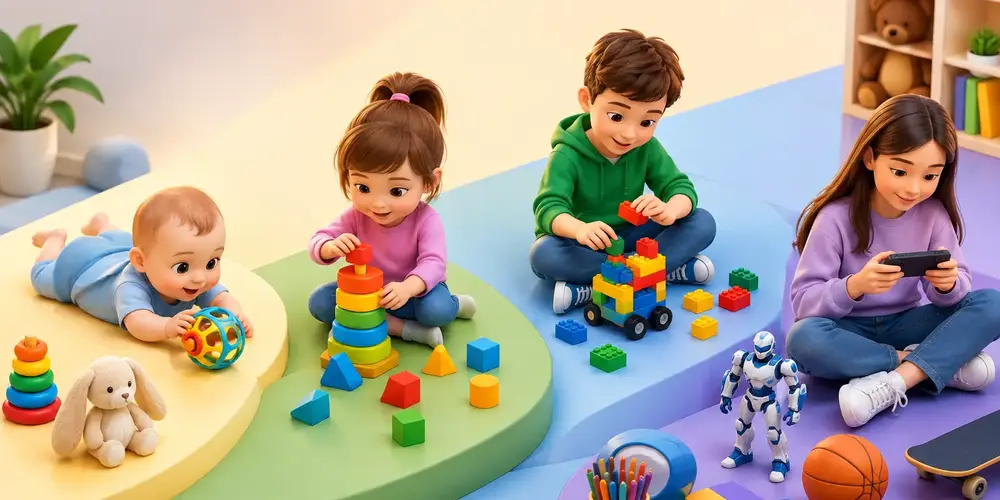
A toy that a child enjoys for five minutes is not automatically a bad purchase, but it is often not the most practical choice either. Knowing how to select toys for different ages can make it easier to find things that a child will actually use, rather than put aside after first opening. Age is an important starting point, but a child's skills, interests and safety requirements should also be considered.
A practical purchase does not need a complicated list. It is enough to check whether the toy is suitable for the child's developmental stage, whether its parts are safe and whether it offers more than one type of play. If toys are being purchased for a shop, gifts or a children's corner in a business, easy restocking and variety in a single order also become important.
How to choose toys for different ages safely
The age indicated on the packaging is not just a recommendation about how interesting the toy will be. It is primarily about safety. Small parts, magnets, long strings, fragile plastic and easily removable elements can pose a risk to small children. That is why you should not give a toy constructor intended for an older child to an infant just because an adult will be nearby.
Before purchasing, examine the materials, part fastenings and shapes. A toy should not have sharp edges, easily torn seams or a strong chemical smell. For soft toys, it is useful to check that eyes, buttons and decorative elements are securely attached. Toys with batteries should have a battery compartment that closes securely.
Remember that each child develops at their own pace. A two-year-old may be very dexterous, but that does not mean they are suited to a toy with small parts. On the other hand, a calm, patient child may become interested in a more complex puzzle earlier than indicated on the packaging. Use the age marking as a safety boundary, then assess the habits of the particular child.
Toys up to 1 year old
In the first year of life, a child gets to know the world through sight, hearing, touch and mouth. At this stage, light, easy-to-grasp toys without small removable parts are suitable. Rattles, teething rings, fabric books, soft balls and simple activity toys help develop grip and stimulate attention.
Too many sounds and bright features are not always an advantage. For some babies, an active toy with several melodies quickly causes overstimulation. A good choice is a toy with one clear function: squeeze, shake, grasp or feel different surfaces.
At this age, care is especially important. Items should be easy to wipe or wash, as they regularly end up in the mouth and on the floor. When buying in bulk for children's events or gift sets, it is better to choose several simple, safe models than one complex toy with many hard-to-maintain parts.
Toys for children aged 1 to 3 years
During this time, a toddler begins to move actively, imitate adults and test how objects work. That is why pull-along and push toys are useful, large building blocks, sorting games, simple puzzles, play crockery and vehicles. Children enjoy repeating one activity many times, for example, putting blocks in a box and tipping them out again.
Play with household item imitations is not just entertainment. A play kitchen, telephone, tools or doctor's kit help a child imitate everyday situations and develop language. There is no need to choose a large set – even a few durable parts can provide broad play possibilities.
At this age, children are not yet able to handle fragile things carefully. If a toy is intended for regular use in a nursery, a guest's house or a family recreation corner, preference should be given to washable, stable and easy-to-store toys. Complex mechanisms can be interesting, but they more often require adult assistance and individual parts disappear more quickly.
Toys at preschool age
From approximately 3 to 6 years old, stories, roles and rules enter play. Children create shops, hospitals, building sites and journeys, so dolls, figures, play furniture, cars, animal sets and creative materials are in demand. This is also a good time for simple board games, where children must wait their turn and follow understandable rules.
When choosing, the duration of play is just as important as the theme. For a preschool child, a toy board game or model that is too complex or has many assembly steps can be disappointing. It is better to start with short activities where results are visible relatively quickly. Once the child gains confidence, more complex sets can be added.
Creative toys are practical because they can be used repeatedly. Plasticine, drawing supplies, stickers, coloured paper and craft kits allow a child to come up with their own solutions. However, there is a compromise: purchasing creative materials often requires adult involvement, preparation of a work surface and tidying up after the activity.
What to choose for school-age children
At primary school age, children more often choose toys based on specific interests. For one child sport will be important, for another drawing, construction, collectible figurines or logic puzzles. At this stage, it helps to ask not just "what does the child want?", but also "what does he already use?". If there are already many similar figurines at home, an addition can only be useful if it expands the existing play.
Builders, model sets, experiment kits, craft supplies and more strategic board games train patience and problem-solving. However, complexity should not be an end in itself. For a child who does not want to sit on one task for a long time, a toy with shorter action steps will work better than a large set that they will abandon halfway through.
School-age children also begin to appreciate the opportunity to play together with friends. Balls, badminton sets, card games and board games are useful for families, groups of pupils and places where simple leisure activities need to be provided. When choosing for such purposes, check how many people the toy is designed for and whether the set contains all the parts needed for use.
Teenagers need interests, not a "toy" label
A teenager often does not want to receive an item that looks childish, even if it is high quality. At this age, it is better to look at hobbies and practical activities: creative sets, more complex brain games, sports equipment, collecting accessories, room décor or small accessories.
A gift does not necessarily have to be chosen by age category. If a teenager likes to draw, materials for a new project will be useful. If they play board games, choose one that is designed for their friend group size. The main thing is to avoid random purchases simply because of a popular theme or bright packaging.
Practical purchase check before ordering
To make toy selection faster, check four things: age indication, safety details, the child's interests and intended frequency of use. If the product is being purchased for resale, add a fifth question - will it be convenient to regularly replenish this product in the range.
In a wide range, it is easy to choose too many similar products. It is smarter to create a combination of different prices and functions: some small gifts, creative activities, active play and sets for shared play. For Lutini.lv customers, this approach allows you to put together practical products in one order for both homes, shop shelves and seasonal events.
The best toy is not the one with the most buttons or the largest packaging. It is a toy that matches the child's current skills, is safe for daily use and gives reason to return to it again.