
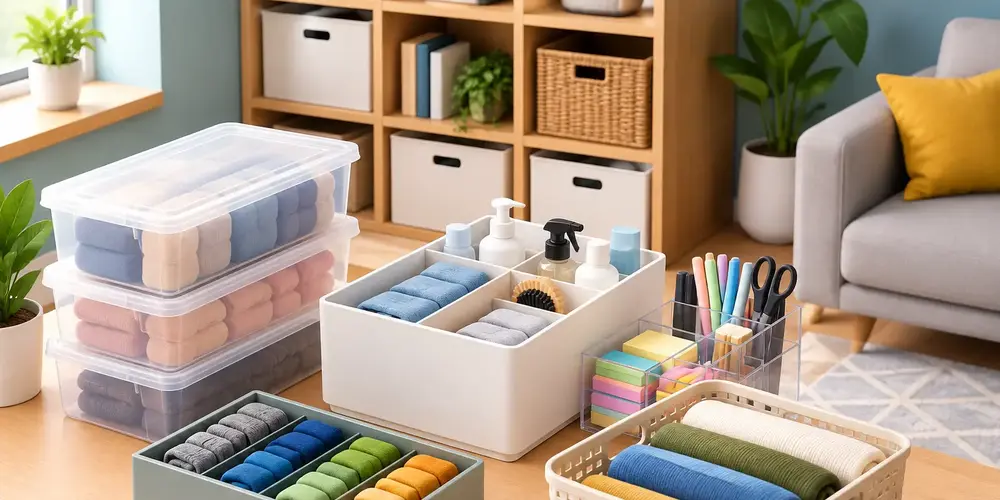
An overflowing kitchen drawer, cosmetics scattered on the bathroom shelf and clothes that don't fit in the wardrobe don't usually mean that there's not enough space at home. More often, there's a lack of a clear system. Home organisation accessories help divide things into zones, maintain visible order and reduce the time spent each day searching for the item you need.
Practical home organisation doesn't require buying lots of identical containers just because they look good on the shelf. First, you need to evaluate the space, frequency of use and quantity of items. Then you can choose simple, affordable and easily replenishable solutions that work for both a small flat, a house, a rental property or a guest accommodation.
Start with the space, not the boxes
A common mistake is to buy storage accessories before understanding what exactly needs to be stored. As a result, another layer of differently-sized boxes appears in the wardrobe, but daily order doesn't improve. First, clear a specific shelf, drawer or wardrobe and divide your belongings into three groups: used every day, needed occasionally and unnecessary or outdated.
Only then measure the available space. What matters is not just the width of the shelf, but also its depth and height. Deep drawers benefit from inserts and dividers, whilst tall wardrobes benefit from collapsible boxes with lids. Items that are rarely used can be placed on higher shelves. Items needed daily should be accessible without rearranging and unnecessary searching.
There's no need to reorganise everything at once. Choose one zone, for example, a kitchen table drawer or a bathroom wardrobe. Once the chosen solution proves itself, it can be repeated in other areas. This approach is also more convenient for businesses that furnish rental flats, office kitchens or guest rooms and want a unified, replenishable order.
Home organisation accessories for each zone
Different rooms require different solutions. One universal box won't solve everything, as kitchen accessories, toys and seasonal textiles are used differently. When choosing products, preference should be given to simple shapes that can be easily cleaned, moved and combined.
For the kitchen - clarity and quick access
In the kitchen, most time is spent searching for small items. Cutlery dividers help keep spoons, knives, scissors and other everyday tools in order. Small plastic boxes are suitable for spice packets, tea bags, baking accessories or snacks. Clear material is convenient because the contents are visible immediately.
In the food wardrobe, boxes with handles that can be pulled out like a drawer are useful. One can hold breakfast products, another tinned goods or baking ingredients. If the household buys larger packages, it's recommended to leave some products in their original packaging and store them in a separate zone. Transferring everything into identical containers looks tidy, but takes time, space and regular labelling.
For the bathroom - solutions for a damp environment
Bathroom shelves quickly become cluttered with care products, cleaning supplies and reserves. Here, it's particularly important that accessories aren't afraid of moisture and are easy to wipe. Low-sided boxes help gather shampoos, creams and shaving accessories in one place, whilst smaller dividers are useful for cosmetics, hair elastics and hygiene products.
Frequently used items don't need lids. A lid protects from dust, but in the bathroom it can become an unnecessary step if you need to open several boxes every morning. Choose lids for reserves, seasonal towels or items that are kept in a higher wardrobe.
For the wardrobe - more space without a new wardrobe
Order in the wardrobe comes not just from folded clothes, but from clear division. Fabric or plastic boxes can be used for socks, underwear, scarves and accessories. If the shelf is deep, it's better to choose several shallower boxes rather than one large one. These allow you to access the contents without disturbing the entire shelf.
Seasonal clothes, blankets and other bulky textiles are worth storing in sealed bags or larger boxes. Before placing them, make sure the items are clean and dry. Damp fabric in sealed storage can create unpleasant odours and damage the material. It's advisable to label each box with a short note, for example, "winter gloves" or "guest bedding".
For the children's room - a system that the child can use themselves
Organising toys requires a simple system. If a child has to open several boxes to find one component, order won't last long. Place light boxes with wide openings on lower shelves, and divide small components by type: building blocks, craft materials, figurines or puzzles.
Visual labels are also useful for children who cannot yet read. You can use a picture or coloured sticker on the box. The key is not to overdo it with overly detailed division. If one set contains many different components, it's more practical to keep them together rather than trying to fit each element into a separate compartment.
How to choose size, material and quantity
Before purchasing, determine whether the accessories will be visible or in a closed cupboard. On open shelves, boxes of similar size and colour look visually neater. In closed cupboards, function is more important – so the box can be easily pulled out, the contents are easy to see and the size uses the available space efficiently.
Transparent plastic boxes are convenient for small items, food supplies and items that need to be found quickly. Opaque boxes are better suited for textiles or things you don't want to keep in sight. Fabric organisers are lightweight and work well for wardrobes, but they are not suitable for damp rooms or storing liquid products.
Buy as many accessories as are needed for a particular area and keep only a small reserve for frequently replenished supplies. Too many empty boxes also take up space. For retail customers, this allows them to organise their home without unnecessary expenses, whilst for shops, accommodation facilities and other business clients it makes it easier to create uniform solutions across multiple spaces.
Order is maintained with simple rules
Organisational accessories produce results only if items have a permanent place. After use, an item should return to the same box, compartment or shelf. Therefore, the system needs to be understandable to all household members, not just the person who created it.
Review at least one area every month. Throw out empty packaging, move items that have ended up in the wrong place and check whether the boxes still match their contents. If a drawer is overfull again, it doesn't always mean you need a larger box. Perhaps some items should be placed elsewhere or are no longer needed.
Practical order at home is not decoration. It is a system that helps you prepare a meal faster, tidy up a child's room, find a charger or prepare guest towels. Start with one shelf and choose accessories that make everyday tasks easier – then order will not be a short-term project, but a convenient habit.


