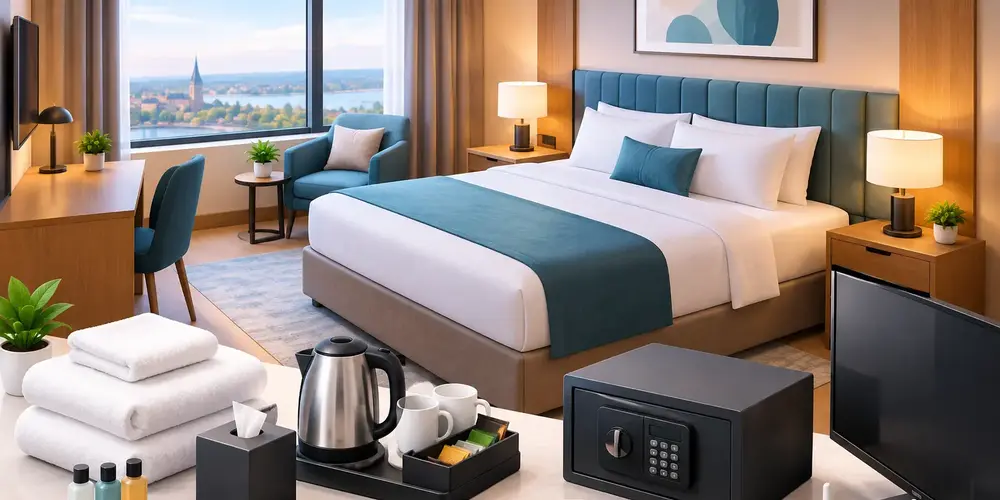
A guest judges room quality within the first few minutes: whether the bed is properly made, whether the bathroom has everything needed, and whether personal belongings can be stored conveniently. This guide for hotel room equipment helps create a practical basic set that is easy to supplement, track and reorder regularly.
Equipment is not just an interior matter. It affects cleaning speed, inventory levels, guest reviews and staff's daily work. The right choice is usually not the most luxurious, but the one that is durable, understandable to guests and available for repeat purchase.
Start with room type and guest habits
A single list for all rooms often creates unnecessary expenses or, conversely, insufficient comfort. For a single business guest, a free power outlet, good lighting and workspace are important. A family room more often benefits from extra towels, coat hangers, a waste bin and a safe place for belongings. For a longer stay, a guest will appreciate more storage space, a complete set of toiletries and the opportunity to maintain order.
Before purchasing, divide rooms into at least basic categories: standard, family, superior comfort and long-term stay rooms. Create your own minimum set for each. This will be clear to staff what to place after cleaning and what needs to be replenished in the stockroom.
It is important to distinguish mandatory from optional equipment. Mandatory is everything without which a guest cannot sleep comfortably or maintain personal hygiene. Optional items improve the experience, but should only be introduced if staff can regularly replenish and check them.
Guide to hotel room equipment: basic set
A practical room starts with quality bedding. Bed linen should be chosen according to size, fabric density, washing mode and supply stability. White or neutral linen facilitates assembly and creates a sense of cleanliness, while darker decorative elements can help hide signs of daily use. The choice depends on your laundry routine and room occupancy.
Each room needs a sufficient quantity of spare sheet, duvet cover and pillowcase sets. If linen is constantly in circulation, even a brief supply delay or a busier booking week can cause problems. It is more practical to keep reserves based on the specific number of rooms rather than buying small quantities only when stock runs out.
Towels are the second most visible quality signal. Usually a bath towel, a smaller hand or face towel and a bathroom mat are needed. Some accommodation providers also offer guests a separate hair towel, but this is justified only if it can be consistently provided in all appropriate rooms. It is worth marking or storing towels of different sizes and colours separately to avoid confusion during cleaning.
The room should also have functional furniture details: coat hangers, a small waste bin, a mirror, space for a bag or suitcase and a sufficient number of surfaces. A guest should not have to think about where to place a jacket, phone or cosmetics bag. If the space is small, choose simple, easy-to-clean solutions rather than lots of décor that takes up space and collects dust.
Lighting should be practical. A single ceiling lamp is not enough if a guest wants to read or prepare for work in the evening. A bedside lamp and clearly accessible power outlets often provide more benefit than complex design elements.
Bathroom items guests actually use
In the bathroom, the main priorities are cleanliness, clarity and the ability to quickly find what is needed. Soap, shower gel or shampoo, toilet paper, waste bags and hygiene bags form the foundation. If you offer small individual packages, check whether they are easy to open and whether staff can replenish them quickly. Larger dispensers reduce packaging consumption, but require regular cleaning and a reliable refilling process.
There is no need to place an extensive range of cosmetic products in every room. Some guests appreciate a toothbrush kit, shaving accessories or slippers, but in other accommodation these items remain unused. A good solution is to keep some additional items at reception or on request. This allows you to help the guest whilst reducing wasteful consumption.
Also check the details: whether there is a toilet brush, whether towel hooks hold firmly, whether the mirror is sufficiently lit and whether the wet area mat does not slip. These are exactly the details that determine whether the room seems tidy and safe.
Additions that improve the stay
After securing the basic set, evaluate the additions. A teapot, mugs, glasses, teaspoons and a small tray are useful in places where guests stay longer or catering is not available nearby. If you introduce these items, you also need a clear washing and inspection procedure.
Information materials should be brief and easy to replace. Provide Wi-Fi information, breakfast times, check-out procedures, reception contact details and the most important safety rules. It is better to place information in one noticeable location rather than scatter it around the room.
Small practical items often make a better impression than expensive décor. For example, a shoe cleaning brush, a clothes brush, spare hangers, a napkin box or a sewing kit can be useful. However, do not put everything in at once. First, select items that meet your guests' needs and are regularly used.
How to order so that you don't run out of stock
When purchasing hotel equipment, the price of a single order is important, but so is the ability to purchase identical items repeatedly. Changing designs, varying towel shades or different soap packaging make it difficult to maintain uniform room standards. Before a large purchase, check the product size, material, packaging quantity and available stock.
Set a minimum stock level for each product group. When the stock reaches it, the order should be placed immediately, without waiting until the last unit reaches the room. This procedure is especially useful during peak seasons, when the workload increases and the cleaning team has no time to look for replacements.
Use clear names and article numbers in your product list. For example, not just "towels", but "white bath towel, specific size" or "hand soap for dispenser". This reduces errors when orders are placed by another employee. Lutini.lv's wide range of everyday products can be convenient if you need to top up textiles, hygiene products and small room accessories in a single order.
Inspection before guest arrival
Even good equipment will not make the right impression if it is arranged carelessly. Cleaning staff need a unified inspection checklist. It helps to spot not only used items, but also damage, moisture, unpleasant odours or missing details.
Before handing over the room to a guest, check the following:
- the bed is clean, made and without visible fabric damage;
- towels, toilet paper and hygiene products are topped up;
- waste bins are empty and equipped with bags;
- lighting, sockets and basic equipment are working;
- information for the guest is current and easy to find.
The checklist does not need to be complicated. Its purpose is to ensure that each room meets one standard regardless of which employee carries out the cleaning.
Review equipment regularly, based on actual consumption and guest enquiries. If a product is requested frequently, it deserves a place in stock. If another sits untouched for several months, free up warehouse space and invest in what actually benefits your guests and team.