
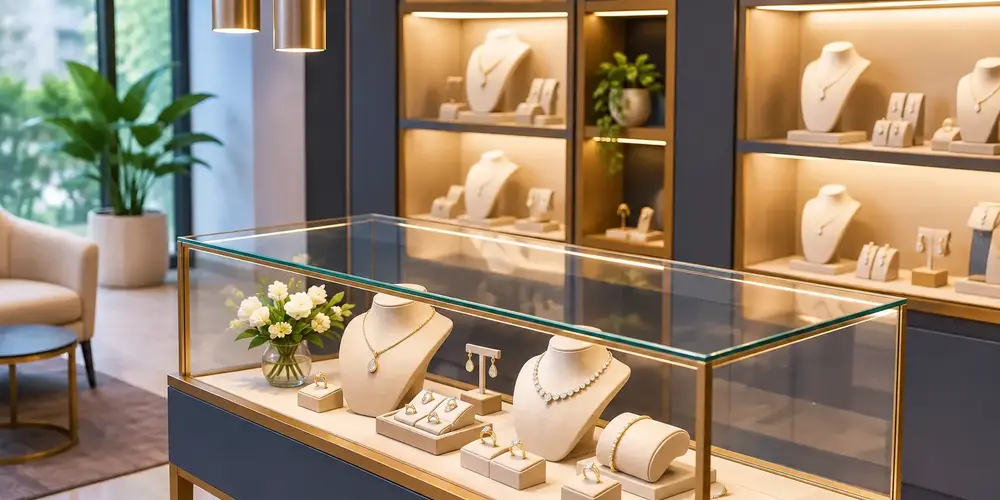
A customer at a display case does not usually choose jewellery after lengthy searching. First they notice the shine, colour or shape, then the price and only then do they take the item for a closer look. Therefore, a guide to arranging jewellery display cases is not only about decoration. It is about clear product selection, convenient overview and the opportunity to sell more without wasting space on unnecessary elements.
For a small shop, sales point or stand, a practical solution is important. The display case should help the customer quickly understand what you are offering: earrings, rings, chains, bracelets, hair accessories or gift sets. If the products are inexpensive and the assortment changes regularly, the layout should be easy to supplement and rearrange.
Start with the display case purpose
Before choosing stands and lighting, determine what the specific display case should sell. Do not try to show all assortment in one display case. Too many different pieces of jewellery in one place creates chaos, and even attractive items disappear in the overall mass.
At the entrance or checkout, small, quickly grasped purchases work best: earrings, hair clips, rings and simple bracelets. In the central display case you can create a themed offering, for example for holidays, seasons or gifts. In a deeper shelf or locked display case, place more delicate, smaller or bundled products.
Give each shelf one clear role. For example, the upper level attracts attention with new items, eye-level positions the most popular items, and below - additional products or stock. This arrangement also makes it easier for staff to top up the display during the day.
Guide to arranging jewellery display cases by zones
The simplest way is to divide the display case into zones by product type and purchase reason. Earrings should be kept together with earrings, not scattered between necklaces and rings. The customer compares similar items, so they need to see several options at a glance.
Main zone at eye level
Here place items with good demand, understandable design and easy-to-read prices. If the shop frequently receives impulse buyers, this is the place for expressive, universal models. Do not overload the zone: leave free space between stands so that each piece is noticeable.
Pay attention to the product size. Small earrings or pendants on a dark, patterned background may look like random dots. They need a contrasting stand and even arrangement. Larger accessories can be placed slightly further apart from each other, as their shape is visible even from a distance.
Side zones for sets and additional purchases
On the sides it is good to place similar products that complement the main selection. Next to necklaces place matching bracelets, next to earrings - rings in a similar tone. Complete sets do not have to be created, but visual compatibility gives the customer a ready-made idea.
If the products are packaged, some packages can be placed upright and some horizontally. Even arrangement is neat, but a completely uniform row sometimes looks flat. Small height differences help you see more products without obscuring them from each other.
Lower zone for stock and children's accessories
The lower shelves are suitable for larger packages, frequently purchased products or children's jewellery and accessories. If you place small items in this location, use shallow compartments or boxes. Otherwise the customer will not notice them, and the seller will find it harder to maintain order.
Lighting shows the true colour
For jewellery, light is not an addition but a sales tool. Insufficient lighting casts shadows, but too sharp lighting creates reflections on the glass and packaging. As a result, the customer sees not the product but their own reflection in the display case.
Choose even, neutral or slightly warm light that allows you to distinguish the metal tone, stone colour and material texture. You should not mix very different light colours in one display case. Silver-coloured jewellery in yellowish light may look different than in daylight, and this can cause unnecessary questions at the checkout.
Position the light source so that it illuminates the product from the front or slightly from above. Check the display case from the customer's point of view - stand a couple of steps away and see if the price tags are legible, if the glass does not reflect and if small items do not remain in shadow.
Background, stands and materials
A neutral background is usually the safest option. White, grey, beige, black or dark blue help the jewellery shape stand out, as long as the colour provides sufficient contrast. Light jewellery against a light background can disappear, whilst dark metal elements on a black stand sometimes lose their outline. Before displaying the entire batch, test a few samples.
Stands do not need to be expensive or ornate. Their purpose is to hold the shape and create order. Necklaces work well on stands, earrings on cards or perforated panels, rings on row holders, and bracelets on cylindrical supports. If you use different stands, maintain a consistent colour or material. This keeps the display cabinet looking tidy even when the range is extensive.
Avoid too much decoration. Artificial flowers, sparkles and large figurines can be useful for seasonal displays, but on a daily basis they take up space, collect dust and distract attention from the product. One small seasonal detail or background accent is usually sufficient.
Price tags and product information without ambiguity
In a jewellery display cabinet, the price tag must be visible immediately. If the customer has to ask the price for each model, part of the selection process won't happen. Indicate the price next to the item or on its packaging, rather than on one shared card for several different products, unless the price really is the same for all of them.
The text should be brief. Usually it is enough to include the product name, material or colour specification, price and, if necessary, the article number. Article numbers are especially valued by retailers and customers who wish to repeat an order or quickly find a particular model in a catalogue.
If the product is a set, state this clearly. Similarly, mention if the jewellery has an adjustable size, clasp or gift packaging. Such information reduces the number of questions and helps the customer make a decision without waiting.
Keep the display cabinet tidy every day
A well-arranged display cabinet loses its effect if it is dusty, with empty hooks or mixed-up price tags. A brief check in the morning and at the end of the day usually takes little time, but significantly improves the overall impression. Clean the glass, straighten the cards, replace sold items and check that the lights are working.
Regularly change the most visible part of the stock. There is no need to rebuild the entire display cabinet at once. It is enough to change one zone, move new models to eye level or create a small colour group. This makes the display cabinet look fresh even to regular customers.
When reorganising the stock, assess not only what you think looks beautiful, but also what customers frequently pick up and what they regularly buy. A practical display cabinet works when it helps people quickly see the selection, understand the price and find the jewellery they are ready to purchase today.