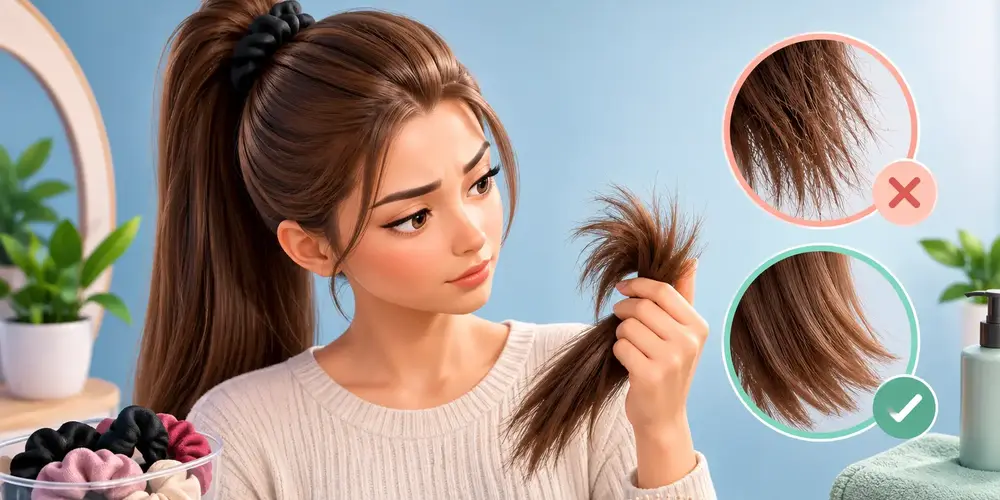
A hair tie that needs to be yanked out of your hair at the end of the day is no trivial matter. It is in these very places that broken hairs, tangled ends, and the feeling that your ponytail is always too tight often appear. Do hair ties damage your hair? Not necessarily in themselves, but the wrong material, too tight a grip, and one habit - wearing hair ties in the same spot every day - can cause visible damage.
The practical approach is not to find one "ideal" hair tie. More importantly, you should choose a hair tie that suits your hair thickness, hairstyle, and usage time. Fine hair needs gentle fixing, thick and heavy hair needs sufficiently firm but not harsh holding. If hair ties are being purchased for a family, salon, shop, or everyday use, it is worthwhile to keep sets of different types rather than one solution for all situations.
How hair ties damage your hair
Hair damage usually does not occur all at once. It forms from repeated friction, pressure, and pulling. When a hair tie is too tight, it pulls your hair in one spot. With movements, head turning, or hair repositioning, this spot gets additional movement, and the hair cuticle can wear away. The result is breakage, especially for dry, bleached, or coloured hair.
The risk is also increased by metal fasteners. A small metal ring can catch individual hairs, pull them out, or break them. This is not always immediately visible, but with regular use of such a hair tie, plucked hairs at the temples and nape can become noticeable.
Another common problem is wet hair. Wet hair is more elastic, but also more sensitive to stretching. A tightly tied ponytail after a shower can leave an impression and increase the likelihood of breakage, especially if the hairstyle is worn like this for several hours. This does not mean that wet hair should not be tied up at all, but it is better to choose a looser braid or a very soft hair tie.
Do hair ties always damage your hair?
No. For most people, hair ties are a normal everyday accessory that causes no problems if used correctly. The likelihood of damage depends on three things: the construction of the hair tie, the condition of the hair, and habits.
Healthy, thick hair usually tolerates more than fine or chemically treated hair. However, even strong hair can suffer if it is pulled tightly into a high ponytail in the same spot every day. Meanwhile, fine hair can look good with a light fabric hair tie if the hairstyle is not overly tight and the hair tie is removed carefully.
The duration of wear is also important. A comfortable hair tie suitable for a working day will not always be suitable for sport, and a firm sports hair tie is not the best choice for sleeping. The longer hair is tied up, the more you should think about tension. If after removing the hair tie you feel headaches, a pulling sensation, or a visible deep line in your hair, the hairstyle was likely too tight.
How to choose a hair tie for everyday hairstyles
Simple fabric hair ties without metal parts are a safe choice for many everyday hairstyles. They usually catch in hair less and are comfortable for a low ponytail, a light bun, or children's hairstyles. The advantage is straightforward - they secure hair without sharp edges. The disadvantage - for very thick hair, they may be too loose or stretch faster.
Spiral plastic hair ties are often chosen because they do not leave such a pronounced impression. They can be useful for medium-thick hair and temporary hairstyles. However, a spiral hair tie can get tangled if you pull it out too quickly from very long or curly hair. It should be unwound gradually, not yanked out in one motion.
Hair ties wrapped in silk or satin-like fabric are suitable for delicate, dry, and easily breakable hair. A smoother surface reduces friction, so such hair ties are often chosen for night hairstyles as well. It should be noted that they can slip from very smooth hair and may not always hold a tight sports ponytail.
Thin elastic hair ties are better left for small locks or short periods of use. They can be practical when creating a more complex hairstyle, but are not a good choice for a large amount of hair. If a thin hair tie needs to be wound many times, the tension becomes unnecessarily high.
Usage habits that reduce breakage
The first rule is simple: do not pull your hair tighter than necessary. If the ponytail holds with one fewer wrap, it is a gentler choice. A very tight hairstyle may be necessary for a specific workout or job, but it should not become an everyday standard.
Change where you place the hair tie. On one day, create a low ponytail; on another day, a looser bun or plait. This reduces constant strain on one section of hair. This is especially important for people who do active work, exercise or keep their hair tied up for several hours due to hygiene requirements.
Remove the hair tie with your hands, rather than pulling it through the hair lengths. First, undo the wraps, then carefully remove the accessory. If the tie is tangled, do not rush. Sometimes it is better to spend a few seconds detangling the hair than to pull out several strands together with the tie.
Regularly check the condition of the hair tie. A stretched tie means you have to fasten it multiple times, whilst a damaged or torn covering can catch hair. The accessory is small, but replacing worn-out ties is a simple way to make everyday hairstyles more comfortable.
What to consider for children and frequent hairstyles
Children's hair generally works better with soft, small fabric ties without metal connectors. Children often move about, pull off hats, nap during the day or try to remove the tie themselves, so an overly tight knot is not necessary. The hairstyle should be stable, but it should not cause complaints about pulling or scalp sensitivity.
If several plaits need to be created in one day, for example for an event, dancing or accessory sets intended for trade, it is useful to choose several tie sizes. Small ties work for details, but for the main securing, it is better to use a wider and softer tie. This way the hairstyle will look neat, but the hair will not be overloaded at one point.
For people with curly or very thick hair, the problem is often not the tie itself, but its diameter being too small. If the tie has to be stretched to the maximum, it pulls the hair and loses its shape faster. A larger size tie will usually hold better with less tension.
When it is worth changing more than just the tie
If hair breaks even when soft ties are used and loose hairstyles are worn, the reason may not be just the accessories. Hair condition is affected by bleaching, heat tools, combing, diet, scalp health and other factors. Marked hair loss, irritated scalp or sudden changes in hair density are reasons to consult a doctor or dermatologist.
For everyday needs, a clear selection is sufficient: soft ties for work and home, a firmer version for sport, smaller ties for plaits and some gentle ties for nighttime hairstyles. This approach is also practical if accessories are purchased in bulk for a family, small shop or customer needs.
A good hair accessory is not one that pulls the tightest. It holds the hairstyle as firmly as necessary, and in the evening allows you to free your hair without pulling, pain and broken strands.