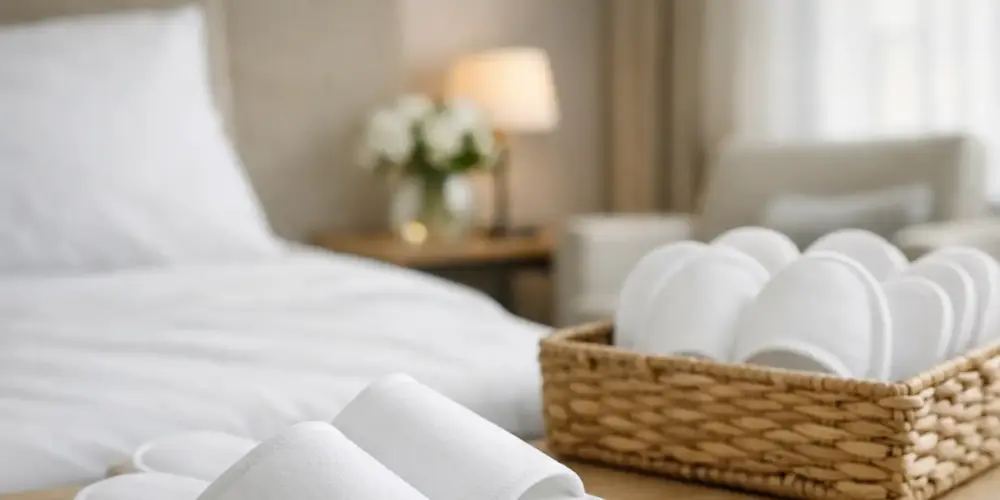
A guest rarely says thank you specifically for slippers, but they very quickly notice if they're not there. That's exactly why disposable guest slippers are not a trifle in many industries, but a basic consumable item. They help maintain hygiene, ease servicing and allow you to ensure an equal level of service without unnecessary costs.
If you're buying items for a hotel, apartments, spa, sauna or short-term rental, this is one of those products worth keeping in stock permanently. Disposable guest slippers don't take up much space, are easy to hand out and don't need to be washed, sorted by size or worry about repeated use. In practical everyday terms, this means less work and more understandable cost control.
Where disposable guest slippers deliver real benefit
Most visibly, they are useful in hotels and guest houses. Slippers left in a room create a neat and finished impression, even if the overall service is simple. A guest doesn't have to walk around the room in street shoes, and maintaining the space becomes easier.
This product is also very often chosen by apartment and rental flat owners. In short-term rentals, every detail affects reviews, but the budget is usually tight. Here disposable slippers are a good compromise between comfort and price. They cost less than reusable textile slippers, and there's no need to organise their washing between bookings.
In spas, saunas, beauty salons and massage cabins, the main argument is hygiene. A guest or client receives a clean pair, used only by them. This is particularly important in places with moisture, shared areas or direct contact with the floor after treatments.
Meanwhile, in hospitals, clinics and social care facilities, not only cleanliness but also logistics matter. Disposable guest slippers are easy to hand out, easy to account for and easy to replenish when stocks are running low.
Why this solution is often more economical than ordinary slippers
At first glance, reusable slippers may seem more economical. In some cases they are, but only if collection, sorting, washing and replacement are clearly organised. In smaller accommodation or facilities with irregular occupancy, this often means extra time for staff and not always predictable costs.
With disposable slippers, the calculation is straightforward. There's a known price per unit, a known consumption per guest, and no hidden costs for maintenance. This is particularly convenient for businesses that need to buy many different household and guest service products at the same time and who want to quickly understand the total budget.
Another plus is flexibility. If the number of bookings increases in season, slippers can be ordered additionally without complicated preparation. If occupancy decreases, the packaging in the warehouse takes up little space and doesn't impose a servicing burden.
What to consider when choosing disposable guest slippers
No complicated specification is needed here, but a few things do determine whether the purchase will be successful. Firstly, the material. Lighter slippers are cheaper and suitable for short use in a room, salon or waiting area. If they're intended for a sauna, spa or longer walking, it's better to look for denser material and a sturdier sole.
The type of sole is also important. For dry areas, a simpler solution is sufficient, but in wet zones you need to think about grip. If floors can be slippery, too thin and smooth a sole is not the best choice, even if the price is lower.
The next point is size and shape. Universal size is the most convenient option for many facilities, as you don't need to store several sizes separately. However, in places where a higher level of comfort is important, it may be worth considering a wider model or several sizes.
You should also look at the packaging. Individually packaged slippers look neater and are convenient for room kits. They also create a cleaner impression for the guest. Meanwhile, bulk packaging can be more economical if slippers are distributed in a treatment room or housekeeping staff assemble them themselves.
Disposable guest slippers for different facilities
Not all buyers need the same thing. For a hotel with daily room turnover, stable supply, consistent quality and predictable consumption matter. Here, the model usually wins that can be reordered repeatedly without lengthy comparison every week.
For an apartment owner, small packaging and a good price per booking may be more important. If there are few units, there's no need to overpay for a more complex product that a guest will use for a few hours or one night.
Spa and sauna complexes more often opt for slightly more durable slippers. Usage there is more intensive, floors can be wet, and the comfort feeling for the guest is directly linked to the material and stability.
Retailers and wholesalers, on the other hand, have a different perspective - a simple product, clear application, broad target audience and good markup opportunity. In this segment it is important that the product is easy to explain to the buyer and that its price remains affordable for the end consumer as well.
Most common purchasing mistakes
The most common mistake is choosing based on price alone. If slippers tear, slip or look too thin, savings can quickly disappear. In guest service, a cheap product is good only if it performs its function without complaints.
The second mistake is ordering too little. Since the product is compact and consumption can grow rapidly during weekends, peak season or group bookings, it is sensible to keep a safety buffer. Otherwise you will need to find an urgent solution, and that usually costs more.
The third mistake is an unsuitable product for a particular environment. Room slippers and spa slippers are not always the same thing. If the environment is wet or the guest walks around for longer, a more suitable model should be chosen, even if it costs a little more.
How to plan inventory without unnecessary complications
A simple approach works well for this product. Calculate average consumption per week or month, add a reserve for the busiest period and check stock regularly, not just when the box is almost empty. Since disposable guest slippers do not take up much space, a small safety stock is usually justified.
If you are also purchasing other guest service or household items, it is beneficial to combine them in one order. This saves time and makes restocking easier. Such an approach is especially convenient for businesses that do not want to order every small item from a different supplier.
A practical solution is to choose one or two proven models and stick to them. Then staff do not have to guess which option to put in the room or hand to the guest, and purchasing becomes faster.
When this product is not the best option
There are situations where disposable slippers are not an ideal choice. If an establishment positions itself as a higher-class accommodation with distinctive premium service, guests may expect thicker and higher-quality slippers. There a disposable solution will only work if it visually and practically matches the overall standard.
For long-term use at home, this is also not an intended product. If a buyer is looking for slippers for everyday use, it is better to look at reusable options. The main advantage of disposable guest slippers is short-term, hygienic and simple use, not durability.
That is precisely why the most important thing is not to find the theoretically best slipper for all cases, but to understand your usage. The clearer the scenario, the easier it is to choose the right price, material and packaging.
In a Lutini.lv type range, the value of such products is quite practical - you quickly find what you need, see availability and can order together with other everyday items. If slippers are needed regularly, that is not a small bonus, but normal work organisation.
Good purchasing in this category is not about luxury. It is about ensuring guests have clean slippers, staff find it simple, and you yourself do not overpay or deal with unnecessary problems after each booking.