
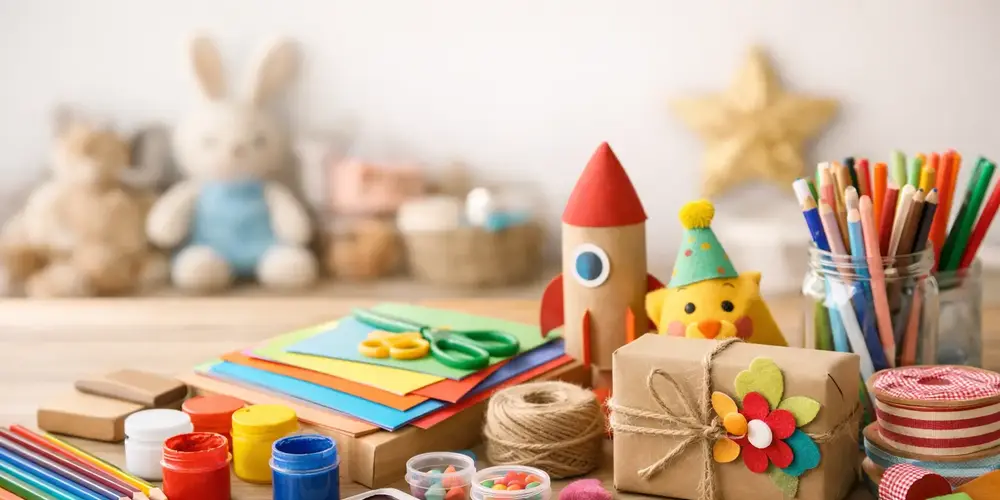
When a child suddenly needs coloured paper, glue, felt-tip pens and stickers too, usually one beautiful set is not enough - you need creative materials for children that are available immediately, cost reasonably and are suitable for actual use. That's exactly why it's worth planning your purchases practically: by age, frequency of use and how quickly materials run out.
How to choose creative materials for children
The first question is not about what looks more interesting. It's more important to understand how your child will use these materials. One child might need colouring and gluing a few times a week, another might need them for nursery tasks, school work or regular crafts at home. This determines whether it's more cost-effective to buy individual items or several basic materials at once.
If the materials are intended for everyday use, the most practical option is usually to create your own set. Separate paper, cardboard, pencils, crayons, glue and scissors are often more practical than ready-made sets with contents where some items remain unused. On the other hand, for a gift or a one-off event, a set can be more convenient as everything is in one purchase.
It's also important to have a reserve. In children's creative work, materials are not used evenly - black felt-tip pens run out faster than yellow, glue sticks disappear faster than cardboard, and stickers get used up in one evening. If you're buying for school, home or a group, it's better to think about repeated restocking rather than just one unit.
Creative materials for children by age
For small children up to school age, the most important thing is ease of use. Thicker crayons, easy-to-grip pencils, safe scissors, modelling clay and larger format paper usually work better than small and fragile accessories. At this age, there's no point in paying extra for highly specialised materials if your child is still just learning to cut, glue and colour.
At primary school age, needs become broader. Collages, themed projects, seasonal crafts and homework appear, where one set of felt-tip pens is no longer enough. You'll need coloured paper, cardboard, gouache or watercolours, brushes, plasticine, stickers, glitter and various decorative trinkets. It's practical to choose materials that can be used for several projects rather than for one specific task.
For older children and teenagers, freedom of choice becomes more important. They often want specific colours, more precise drawing tools, better quality paper or materials for crafts, decoration and gift-making. At this stage, the cheapest option is not always the best, because paper that's too thin, dry markers or poorly-sticking details simply won't be used. However, there's no need to overpay for professional-grade materials if they're intended for a hobby or school.
What is usually needed most often
Your basic shopping basket usually needs to cover several simple needs: drawing, colouring, cutting, gluing and decorating. That's why coloured pencils, felt-tip pens, wax crayons, coloured paper, cardboard, glue sticks, scissors and plasticine are most commonly sought after. These are materials suitable for home, school and gifts.
Then come additions that make projects more interesting, but are not essential every day. These can be stickers, decorative tapes, pom-poms, sequins, wooden sticks, googly eyes, beads or various themed decorations. These items are particularly useful during the festive season, at children's events and when materials are needed not just for one child but for several.
If you're buying for a class, club or small shop for resale, demand usually concentrates on these basic groups. They sell quickly, are understood by the customer and don't require lengthy explanation. In practical terms, this means one thing - it's better to keep stable basic materials in your range or at home rather than rely only on seasonal goods.
When it's more economical to buy separately rather than in a set
Sets seem convenient, but they're not always the most economical solution. If your child regularly draws and glues, separately packaged materials are often more cost-effective because you can top up only what truly runs out. This is especially relevant for paper, cardboard, glue and felt-tip pens.
Sets are a good option when you need a quick solution for a gift, an outing, a children's party or a first purchase to get acquainted. They reduce decision-making time and help you understand what your child likes. However, in the long term they tend to contain less-used items that sit unused.
Therefore, the decision depends on the purpose. For everyday use - often individual materials. As a gift or for a one-time event - a set. If you need a balanced option, you can take one basic set and add separate frequently used items to it.
Practical purchasing criteria
When choosing creative materials for children, you should not only look at the price per package. It is more important to understand the price-to-quantity ratio and actual use. A cheap marker set is not a good deal if it dries out quickly. An expensive decoration set is not needed if it will be used for one school assignment.
It makes sense to pay attention to package size, number of units, and whether the product is easy to replenish. For families with multiple children, kindergarten groups, schools and event organisers, this question is even more important, because even a small price difference quickly becomes noticeable in larger volumes.
Another practical factor is the availability of assortment in one place. If paper has to be found in one place, colours in another, and stickers somewhere else entirely, not only the budget is spent, but also time. Therefore, it is often more advantageous for buyers to choose a wide, clear assortment with visible availability, where you can gather everything in one purchase.
Creative materials for children for school, home and gifts
For home, a universal basic stock works best. This means that a child can sit at the table and start working without an additional trip to the shop. This is not about large investments - rather about always having paper, colours and gluing supplies at hand.
For school, predictability is important. Some materials will be needed all year round, some - during specific academic periods, for example, in holiday decorations or thematic projects. If a purchase is delayed until the last moment, the choice is usually worse and the process more expensive. Therefore, for school needs, basic items are worth getting in advance.
For gifts, more visually appealing solutions are often chosen, but there is no need to complicate things here either. A child usually benefits more from a set that can be used immediately, rather than decorative packaging with little usable content. If the gift is intended for a wide age range, the safest option is universal drawing and craft materials.
What to consider for traders and bulk buyers
In retail and resale, the most important thing is not the theoretically most interesting assortment, but what moves regularly. Creative materials for children are in demand all year round, but peaks occur before the school season, holidays and children's events. Therefore, it is more advantageous to rely on proven basic items and seasonally add thematic supplements.
A wide, low-priced assortment is also important to the end buyer. If you can get both simple pencils and paper, as well as cheap decorations in one place, the purchase happens faster. It is precisely this convenience that often determines the choice in favour of warehouse-type e-commerce, where product availability is visible and no time is wasted on lengthy searches.
Lutini.lv type assortment works well here precisely for practical reasons - in one order you can gather not only creative materials, but also other everyday items. It is convenient for families, small traders and those who are buying for multiple needs at once.
The most common mistake - buying too specifically
Many buyers start with the idea of one specific craft project. This is understandable, but often not economical. If you are only buying for one project, much of the materials remain unused afterwards. It is more practical to choose universal basic materials that can be reused in various combinations.
Children's interests also change quickly. Today you need applications, next week drawing, then modelling. Therefore, the safest purchase is usually not the most thematic one, but the one that provides more usage options. This helps control spending and reduces spontaneous additional purchases.
If a purchase is made with convenience, price and reusability in mind, creative materials for children serve better and cause less stress in moments when they are needed right away.


