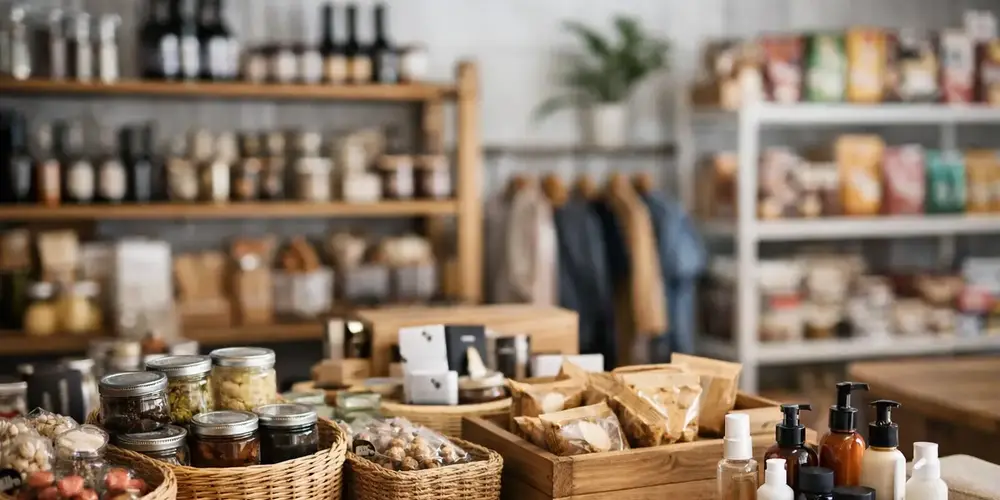
A small shop's shelf earns not with the loudest idea, but with goods that people pick up without much thought. That's why the best products for small shops are usually not complicated or exclusive. They are accessible, understandable, regularly requested and easy to replenish when stock starts to run low.
In small retail, a mistake usually costs more than in a large chain. If too narrow a range is purchased, the product sits. If too expensive a position is chosen, it takes up space and slows down turnover. That's why the range should be built not according to personal taste, but according to a simple question - what is the customer ready to buy quickly, often and at a reasonable price.
How to identify the best products for small shops
Before selecting specific categories, you should look at four practical criteria. The first is turnover speed. The second is the mark-up opportunity. The third is how easy it is to store and replenish the product. The fourth is whether it has stable demand throughout the year or at least in a certain season.
For small shops, products with low or medium prices that people can add to their purchase spontaneously usually work best. Accessories, small gifts, office and school supplies, household products, children's items and seasonal ranges work well here. Such products don't need a long explanation and can be displayed either at the main shelf or in the checkout area.
The cheapest product is not always the best. If a product is of poor quality, returns and customer dissatisfaction can eat up all the profit. Too expensive a product is not always bad either, but it already needs a more precise customer flow. That's why the safest model for a small shop is a balance between low-price everyday products and a small selection of visually appealing impulse purchases.
Product categories that work most steadily in small shops
Toys and small children's products
Toys are one of those categories where a small price often means a quick purchase decision. Simple toys, activity sets, small souvenir-type children's products and seasonal offers sell well in small shops. Parents, grandparents and visitors often look for something quick and not too expensive.
An important condition is that the range should be diverse in price levels. If all products are in one segment, the customer chooses less. If there are some cheap products, some mid-range and a couple of more noticeable new items, the purchase happens more easily.
Office supplies and school items
Office supplies are rewarding because they are bought repeatedly. Pens, pencils, notepads, folders, glue, rulers and other simple items don't require a special season, although demand increases particularly rapidly at the start of the school year.
This category is also good because it allows you to create sets. A customer can come for one thing but take several. In a small shop, this is important because it increases the average purchase amount without aggressive selling.
Hair accessories and jewellery
These are classic impulse products. They take up little space, are visually noticeable and are often purchased without prior planning. Elastic bands, clips, hair ties, bracelets, earrings and other small accessories work especially well in places with regular foot traffic.
However, you need to consider the audience. If the shop is next to a school, a different range will work than in a place where customers are mainly adults. A small shop doesn't need to take everything. It's better to choose a compact, understandable range and update it regularly.
Household and everyday products
Small baskets, kitchen supplies, cleaning accessories, storage accessories and other practical home products are steady sellers because they solve everyday needs. The buyer often doesn't expect special design, but wants understandable function and reasonable price.
Here the principle works well - the product should be easy to understand at a glance. If the customer immediately understands what the product is for and how much it costs, the chance of selling increases. The less thinking required, the greater the shelf turnover.
Gifts and seasonal products
The holiday period can give small shops very good turnover if the range is prepared in time. Gift bags, decorations, small gifts, festive accessories, Valentine's Day, Easter, back-to-school and Christmas products help attract customers even when they originally came for a different product.
In this category, timing is what matters most. If a seasonal product arrives too late, it no longer works at full capacity. If too much is ordered, after the season it becomes frozen money. That's why a small shop is better off planning in smaller batches and replenishing stock based on actual demand.
Hotel, guesthouse and household necessity products
If a small shop also serves businesses or is located where there are accommodation facilities and rental properties nearby, household and guest-use products work well. These can be towels, tea towels, simple textile products, organisational items or other everyday needed products.
This segment is not as impulsive as accessories, but it can generate repeat orders. It is precisely these repeat purchases that are especially valuable for a small shop, as they reduce the need to constantly search for new customers only.
How not to create an assortment that gets stuck on the shelf
A common mistake is offering too much choice in one niche. If a small shop has ten similar products with no clear difference, the customer doesn't choose more but postpones the decision. It's better to have fewer items but clearer logic – the cheapest option, the most popular option and a slightly more visually attractive option.
The second mistake is purchasing only by the lowest price. If a product looks poor or is awkward to use, it doesn't become a good product simply because it costs little. In small shops, reputation builds quickly. If a person buys a poor-quality product several times, next time they won't pay attention to other items either.
The third mistake is not monitoring leftovers. If it's not clearly visible what moves and what doesn't, the assortment starts to grow in the wrong direction. It's more practical to regularly review products by turnover rather than by feeling. If a specific item hasn't moved for a long time, it shouldn't continue to take up space just because it once seemed promising.
Which products have the best potential at the checkout area
If space is limited, the checkout zone is one of the most valuable locations in the shop. Small, understandable and inexpensive products work well there. Hair accessories, jewellery, pens, small gifts, children's trinkets and seasonal novelties often generate more than some of the larger shelves.
Here, regularity is important though. If the same products are always at the checkout, the buyer stops noticing them. A small rotation helps maintain interest without major changes throughout the shop.
Why supplier choice is as important as the product
Even a well-chosen assortment won't work if replenishment is slow or unclear. For a small shop, it's important to see the price, available quantity and understand whether the product can be reordered without excessive waiting. The simpler the purchasing process, the less time is spent on administration.
That's why in practical procurement, a supplier with a wide assortment across multiple categories is of great importance. This allows you to source products for different types of customers in one place, rather than spending time on many separate orders. This approach is especially beneficial for small shops that need to quickly replenish both everyday items and promotional or seasonal stock. Clear stock visibility is also important here, valued by both experienced traders and those who order simply and regularly.
How to start if your budget is limited
If you can't build a large assortment straight away, start with three to five categories that have clear demand in that particular location. Usually the safest start is stationery, hair accessories, small toys, household trinkets and some seasonal products. These categories allow you to relatively quickly understand what moves best.
Then you should look not only at what is bought most often, but also at what is bought together. If a customer often adds a gift bag with a toy or a pen with a notepad, that's exactly where the next addition should go. A small shop makes money not from a maximally full shelf, but from a cleverly arranged shelf.
The best products for small shops are not a universal list for everyone. They are products that move quickly in that particular location, are easy to replenish and provide stable profit without excessive risk. If the assortment is based on practical demand, clear pricing and regular stock control, the shop operates more smoothly and sells more with fewer mistakes.