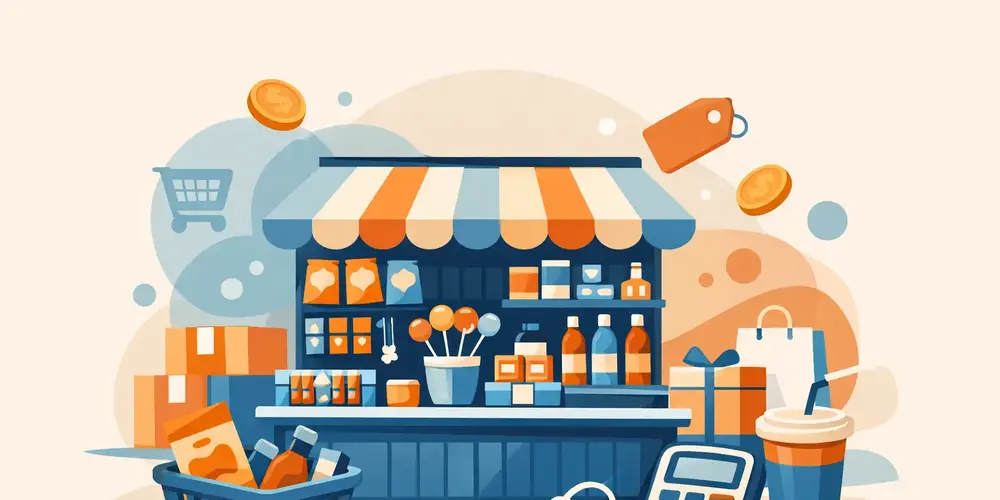
Kiosk profits are often not determined by one expensive item, but by dozens of small purchases throughout the day. Therefore, the best cheap goods for kiosks are usually not complicated or niche products - they are simple, understandable and quick to grab without long deliberation. A customer at a kiosk rarely comes after lengthy comparison. They want to see a familiar, cheap and useful product that they can add to their purchase immediately.
Kiosks work best with an assortment that has a low unit price, compact size and clear application. The easier it is for a customer to understand why this product will be useful to them today, the greater the chance of an impulse purchase. This is exactly why a successful kiosk assortment is usually based on small goods, seasonal rotation and regular restocking, rather than a wide but slow-moving offer.
How to choose the best cheap goods for kiosks
The first criterion is turnover speed. A cheap product in itself does not yet guarantee good results. If it sits on the shelf for months, it takes up space and freezes money. Kiosks need products that can be sold frequently, easily displayed and quickly restocked.
The second criterion is universal demand. The broader the audience that understands a product, the safer the purchase. This is especially important in places with random foot traffic - near public transport stops, markets, schools, stations or seasonal trading points. Here specific products work less well than everyday small items, gifts, accessories and children's products.
The third criterion is a price that the customer perceives as an easy decision. In a kiosk, items sell well that a customer can buy without long deliberation - a small toy for a child, a hair tie, a pen, a gift trinket or a seasonal accessory. If the price is understandable and the product looks useful or appealing, the decision happens quickly.
The product must be simple to sell
The kiosk environment is not suited to complex consultation. Therefore, products that do not require explanation are the winners. The customer must see what it is, how much it costs and why it is worth taking. If a product's value can be understood in three seconds, it is much more suitable for a kiosk than a product that needs a demonstration or detailed description.
Product categories that work best in kiosks
One of the most stable segments is stationery small goods. Pens, pencils, erasers, rulers, notepads and memo pads sell well in places where schools, offices or service points are nearby. These products are not seasonal fashion, they are an everyday necessity. Moreover, they are easy to store and convenient to restock.
Children's small goods and cheap toys are also a very good choice. Small sets, stickers, colouring products, simple toys and surprise items encourage impulse purchases. Parents often make quick decisions about small amounts if the product creates immediate interest for the child. Visual appeal and visible price are important here.
Hair accessories and costume jewellery are another product category with good potential. Hair ties, clips, headbands, simple bracelets and earrings do not take up much space but offer the opportunity to create a wide selection in a small display. Assortment variety works well here - different colours, shapes and packaging.
Gift and festive trinkets often bring in more revenue in kiosks than initially appears. Gift bags, decorative ribbons, greeting cards, small souvenir items and seasonal decorations are typical last-minute purchases. Timing is important in this segment. If a product is displayed before the season starts, rather than after it, turnover will be better.
Household small items are also a safe category, especially in a kiosk with local customer traffic. For example, sewing supplies, bags, simple kitchen tools, batteries, napkins or small household items. These are not emotional products, but they are bought because they are needed right away.
Seasonal goods provide volume but require discipline
Seasonal assortment can provide very quick turnover. In winter these can be gloves, hats, festive decorations and gift wrapping. In spring and summer - sunglasses, hair accessories, children's outdoor small goods, festive attributes. In autumn, school products and demand for warm accessories become active again.
However, seasonal products have one rule - buy in time, but not too deeply. If a product does not sell during the seasonal window, it has to be kept in the warehouse until the next year or sold at a reduced margin. A kiosk usually benefits more from a short, active season with regular restocking rather than an excessively large initial volume.
What not to overestimate in a kiosk
Not every cheap product is a good kiosk product. One frequent mistake is too broad an assortment with many slow-moving items. This creates the impression that there is a wide choice, but in reality, only a small portion of products make up the turnover. If space is limited, every hook, basket and shelf must work.
The second mistake is buying only at the lowest price. If a product looks low-quality, unclear or unappealing, a low price won't help. In a kiosk, visual impression is very important because the buyer makes a decision quickly. Cheap products don't need to be expensive, but they need to look sellable.
The third mistake is ignoring the specifics of the location. What works near a school won't always work at a tourist spot or a small neighbourhood kiosk. If customers are mainly parents with children, you should think about one type of assortment. If the flow is mostly adults and hurried buyers, practical everyday small goods will work better.
How to build an assortment with low risk
The safest model for a kiosk is to combine a core assortment with rotating items. The core should consist of products that move all year round – stationery items, accessories, cheap gift products, children's small goods and small household items. These create stable daily turnover.
Alongside this, you need a small portion of variable assortment. These can be seasonal products, novelties, visually striking impulse purchases or thematic collections for a specific time. This model allows you to maintain stability whilst testing what works better in a particular location.
Purchasing flexibility is also important. Small kiosks usually can't afford to put a large share of the budget into one category. It's more practical to purchase several groups of cheap products in smaller quantities, monitor turnover and then replenish what sells fastest. This is where a supplier with a wide selection and clearly visible product availability comes in handy, as it reduces the time between need and replenishment.
Best cheap products for a kiosk by buyer type
If a kiosk operates near a school or in a residential area, children's products, stationery and cheap accessories play a larger role. There purchases are often spontaneous, small and regular. If the location is near a transport flow or in the centre, practical everyday products, small gifts, sunglasses, batteries or other quickly understood purchases can work better.
In seasonal trading points, you need to think even more practically. The assortment must be visually strong and fast-selling. The buyer often doesn't know the point, they simply see a product and make a decision. For this reason, compact, colourful and price-wise easily accessible products work very well in such places.
If the kiosk targets gift, holiday or fair buyers, you should increase the proportion of decorative and emotionally understandable products. Meanwhile, in a regular neighbourhood point, greater value will be in useful things that can be purchased between other tasks without special planning.
Why delivery convenience is so important in this segment
In the cheap products business, profit is often eaten not by price, but by inefficient purchasing. If after a small replenishment you have to look for several suppliers, spend time comparing and wait for unclear delivery times, the main advantage is lost – fast turnover. This is why it's beneficial for kiosks to work with a wide assortment in one place, where stock, prices and product categories are clearly visible.
This approach helps not only save time, but also better plan cash flow. If a trader sees what is available immediately and in what quantities, they can make a calmer decision about replenishment. This is especially important for cheap products, where profit comes from volume and regularity, not from high margin per unit. For this reason, many kiosk and small shop buyers choose suppliers like Lutini.lv, where several product groups can be collected in one order.
If a kiosk needs to choose where to start, the safest path is not to look for one wonder product. Much better are small, thoughtful assortments with products that people understand immediately, buy without long thought and return to repeatedly. That's where stable turnover begins.